

I recently came across a post from a well-followed principal that sparked a wave of disagreement and discomfort. In it, he compared classrooms to churches, movie theatres, and courtrooms. His argument was simple: if people can remain quiet in these spaces, then classrooms should be quiet as well. Talking over the teacher, he suggested, should be met with consequences such as detention, a seat change, or a call home.

At first glance, this seems reasonable. I agree that classrooms should be respectful spaces. When someone is speaking, whether that someone is a teacher or a student, others should be listening. Respect matters. Learning environments work best when people feel heard, not drowned out.
But the comparison itself is deeply flawed. Comparing classrooms to churches, movie theatres, and courts is not only misleading. It reveals a troubling overreliance on compliance as a model for learning. It’s not apples to oranges; it’s apples to rocket ships. These spaces operate on fundamentally different assumptions, motivations, and power structures.

Let’s start with courtrooms.
People are quiet in court because the compliance model is absolute and intimidating. It is enforced through authority, hierarchy, and fear of consequence. Speak out of turn and you are removed, fined, or worse. Silence in this context is not engagement. It’s survival. While order is necessary in legal proceedings, this is not an environment designed for curiosity, risk-taking, or learning.
The question educators must ask is this: do we really want classrooms where students are silent because they are afraid to speak? Where participation is stifled by fear rather than encouraged through trust?
Next, consider churches.
Most people who attend church choose to be there. Choice matters. As a child, church was rarely a voluntary experience for me, and I suspect I wasn’t alone. I remember zoning out through sermons that felt endless and abstract, only to be handed a colouring page to get me through the boredom. Eventually, once the adults decided we’d reached the collective boredom threshold, the children were invited to the front for a story more attuned to their age, before being sent off to Sunday school.
That last part is telling. Even in an institution built on tradition and reverence, adults acknowledge that children can’t be expected to sit quietly and passively for extended periods of time. Engagement requires adaptation. It requires understanding your audience. If churches, with centuries of precedent behind them, recognize this, why do we expect more compliance from students in classrooms?
Then there’s the movie theatre.
Recently, I attended what may have been the worst movie I’ve ever seen. I won’t name it. I was dragged along by a friend who dropped the name of an actor I like as bait. The theatre seated around 200 people. Maybe a dozen showed up.
I knew the social contract going in: sit quietly, react at appropriate moments, don’t disrupt others. But within ten minutes, regret set in. I questioned my decision to attend, and briefly, my friendship (not really Dino). Should I leave? That felt rude. So instead, I leaned over and whispered commentary to my friend. At times, that whisper slipped into audible disbelief: “Are you serious?” “What is this?” I wasn’t alone. Others did the same. One couple walked out entirely.
Here’s the key difference: everyone in that theatre chose to be there. And still, silence was conditional on engagement. Now imagine filling the remaining 188 seats by gathering people off the street and forcing them inside. Sit down. Be quiet. You must watch this. The chaos would be inevitable.
That’s the reality of school.
Students don’t choose to attend. They bring with them different needs, interests, energies, and stressors. Expecting universal, constant silence ignores both human nature and everything we know about learning.
The problem with framing classroom management solely around quiet is that it confuses compliance with learning. Silence can look like engagement, but it often masks disengagement, confusion, resentment, or apathy. When students are trained to “sit there and be quiet,” (like the way corporal punishment intended) we may get order, but we lose voice, agency, and critical thought. This is what corporal punishment sought to achieve.
This matters beyond school walls. In an increasingly oligarchic society, silence has been modeled and rewarded for generations. Don’t question. Don’t interrupt. Don’t challenge. Just comply. Education should be the place where that cycle is disrupted, not reinforced.
Which brings us to the real question: not why classrooms need to be quiet, but when.
There are moments when silence is appropriate, when someone is sharing, when dignity requires attention, when reflection is needed. But learning is also noisy. It’s collaborative. It’s messy. It’s built through discussion, debate, and shared meaning-making.
If we want students who can think, speak, challenge, and contribute, then we must design classrooms that value more than quiet. Respect does not require constant silence. And learning certainly doesn’t thrive on fear.
The goal isn’t quieter classrooms.
It’s more meaningful ones.

If this resonates with you, the next step is not to abandon structure. It is to build a better kind of structure. The free Web of Rights Starter Guide introduces a practical way to move classroom conversations from compliance toward safety, dignity, voice, and shared responsibility.
Download the free Web of Rights Starter Guide and begin with one classroom conversation this week.
When your child comes home upset about something that happened at school, it can be hard to know what to do first.
Part of you wants to protect them immediately. Part of you wants to email the teacher before the backpack has even hit the floor. Part of you may wonder whether your child is telling you the whole story, whether the school handled it well, or whether this is one more moment in a pattern you have been trying to name for a while.

When a child is upset about school, they are often telling us more than the facts of one moment. They may be telling us they felt embarrassed, confused, dismissed, unsafe, left out, misunderstood, or powerless. Sometimes the issue is serious and needs immediate action. Sometimes it is a conflict that can be resolved with better communication. Sometimes it is simply a hard day.
The challenge for parents is sorting those possibilities without dismissing the child, blaming the school, or rushing into a conversation before the situation is clear.
This is where a calm first step is so key to a healthy school relationship.

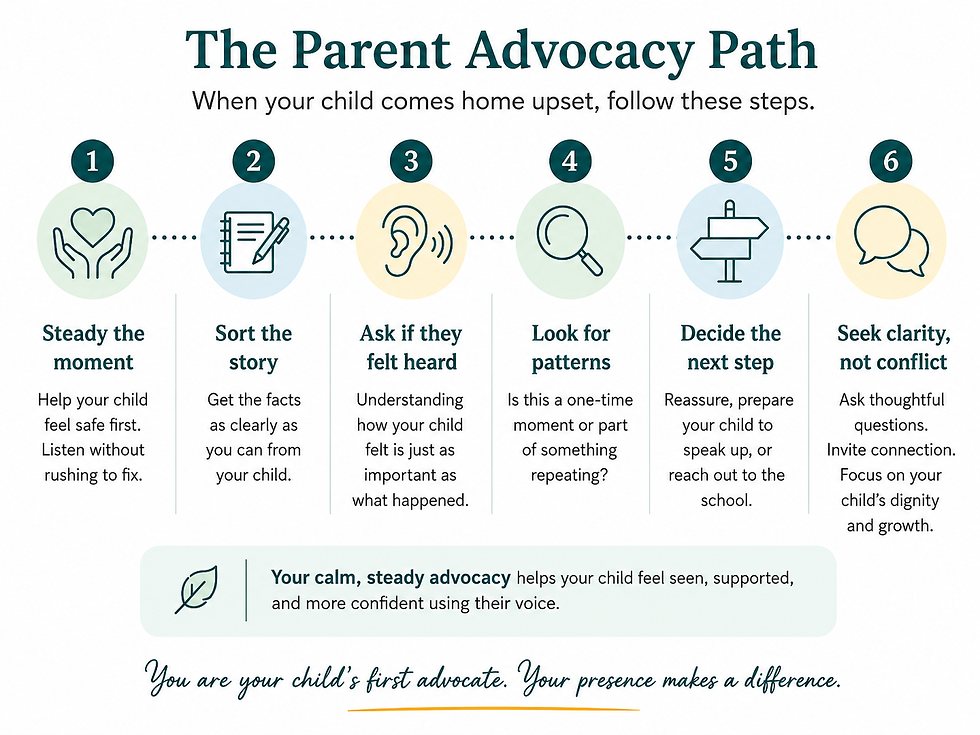
Start by slowing the moment down
When a child comes home upset, the first job is not to investigate like a lawyer. It is to help them feel steady enough to tell the story.
That sounds simple, but it is easy to skip. Adults often move quickly into questions. What happened? Who did that? Did you tell the teacher? Why didn’t you say something? What did you do? Those questions may be important later, but they can feel like a lot when a child is already upset.
A better first move is often something like: “I can see this really bothered you. Let’s slow it down and figure out what happened together.”
That kind of sentence does a few important things. It tells your child you are listening. It does not assume they are right about every detail. It does not assume the school is wrong. It creates enough space for the story to become clearer.
Children do not always have the full language for what happened. They may tell the story out of order. They may focus on the part that felt most unfair. They may leave out context, not because they are trying to mislead you, but because they are still making sense of it themselves. Slowing down helps for everyone.
Sort the story before you solve the problem
Once your child is calmer, try to separate the story into a few pieces.
What happened first?
What did the adults say or do?
What did your child say or do?
What was the final decision or outcome?
What part felt most upsetting to your child?
This is not about doubting your child. It is about helping them move from emotion toward understanding.
A child might say, “My teacher got mad at me for no reason.”
That may be exactly how it felt. But before a parent can advocate well, it helps to know more. Was there a direction your child did not understand? Was there a conflict with another student? Was your child corrected publicly? Were they given a chance to explain? Did they know what they were supposed to do next?
Ask whether your child felt heard
One of the most useful questions a parent can ask is not only, “What happened?” It is, “Did you feel like you had a chance to explain your side?”
This question matters because children can often accept limits more easily when they understand the process. Being heard does not mean they get their way. It does not mean the adult gives up authority. It does not mean every school decision becomes negotiable.
Being heard means the child had some access to explanation, participation, and dignity. They understood what happened and why. They had a developmentally appropriate chance to share their perspective. They were treated with respect, even if the answer was still no.
That is very different from a child simply being told the outcome after the fact.
Sometimes children are upset because they did not like the consequence. That is real, but it may not mean something went wrong. Other times, children are upset because they never understood the decision, never had a chance to speak, or felt shamed in the process. That is worth paying closer attention to.
Look for the difference between a hard moment and a pattern
Not every upsetting school moment requires advocacy. Children will have hard days. They will misunderstand directions. They will experience disappointment. They will navigate conflict with peers. They will sometimes be corrected by adults, and correction can feel uncomfortable even when it is appropriate.
The question is whether the situation appears to be isolated or part of a pattern.
A single hard day might call for reassurance, reflection, and perhaps a small follow-up. A pattern may need more direct advocacy.
Pay attention if your child repeatedly says things like, “No one listens to me,” “I never know why I’m in trouble,” “They always believe the other person,” “I don’t want to tell the teacher because it won’t matter,” or “I just stopped trying.”
Those kinds of statements may point to something deeper than one bad afternoon. They may suggest a gap in voice, explanation, safety, belonging, or dignity.
That does not automatically mean the school does not care. Schools are busy places. Teachers and administrators are often managing many needs at once, sometimes inside systems that do not make careful communication easy. But even when the cause is not lack of care, the impact on the child still matters.

Decide whether to contact the school
After you have listened, slowed the story down, and looked for patterns, you can decide whether school contact is needed.
Sometimes the best next step is to help your child prepare to speak to the teacher themselves. You might ask, “Would you like help thinking through what you could say tomorrow?” or “What would you want your teacher to understand about how that felt?” This builds your child’s capacity to use their voice respectfully.
Other times, especially with younger children or more serious concerns, parent contact is appropriate.
When reaching out, try to keep the first message calm, specific, and process-focused. For example:
“Hi [Teacher Name], my child came home upset about something that happened today. I’m still trying to understand the situation clearly. Would you be able to help me understand what happened, how the decision was made, and what support will be in place moving forward?”
That kind of message does not accuse. It opens a door. It also keeps the focus where it belongs: understanding, process, support, and next steps.
Helpful questions to ask the school
When you do contact the school, it can help to use questions that invite clarity rather than defensiveness.
You might ask how the decision was made, whether your child had an opportunity to share their perspective, how expectations were communicated, what support is in place now, what you might reinforce at home, and whether the school is noticing anything that would help you understand the bigger picture.
These questions help shift the conversation away from sides and toward shared understanding.
That matters because most parents and educators want the same broad thing. They want the child to be safe, supported, accountable, and able to learn.
The conversation goes better when everyone can stay connected to that shared ground.

What your child learns from how you respond
Children learn a lot from how adults respond to school concerns. If we dismiss them too quickly, they may learn their voice does not matter. If we rush in too aggressively, they may learn that advocacy means conflict. If we slow down, listen carefully, ask better questions, and seek understanding, they learn something more useful.
They learn that their feelings matter, but feelings are not the whole story. They learn that adults can hold concern and fairness at the same time. They learn that asking for clarity is not disrespectful. They learn that using their voice can be calm, thoughtful, and constructive. That is the heart of parent advocacy.
It is not about taking over every school problem. It is about helping children understand what happened, recognize when something felt wrong, and learn how to move forward with dignity.
A simple first step
The next time your child comes home upset about school, try starting here:
“I believe that this felt upsetting. Let’s slow it down and understand what happened.”
Then listen. Not to build a case. Not to dismiss. Not to rush. Listen so you can help your child move from confusion toward clarity.
Sometimes that will lead to a conversation at home. Sometimes it will lead to an email. Sometimes it will lead to a meeting. Sometimes it will simply help your child feel less alone.
But in every case, the message is the same: your voice matters, we will use it thoughtfully, and we will work toward understanding before we decide what comes next.
Next step
If your child has been coming home upset and you are unsure how to approach the school, start with the free guide, Helping Your Child Be Heard at School.
For a more structured way to prepare for a conversation, the Parent Advocacy Conversation Guide can help you organize what happened, what questions to ask, and what next step would be most constructive.
Real change in public education is not about polished slogans or performative innovation. It is about noticing where the system stops serving students well, listening carefully to the people inside it, and helping guide change toward something more honest, more humane, and more worthy of the community it is meant to serve.
The phrase change agent gets used so often in education that it can start to feel strangely hollow. It appears in leadership bios, school improvement plans, professional learning spaces, and conference language until it begins to sound less like a serious responsibility and more like a flattering title adults give themselves when they want to sound forward-thinking.
But real change in public education is rarely flattering. It is rarely smooth. And it almost never begins with a slogan.

We would be hard pressed to find anyone who truly believes change can be avoided. At every level of life, change keeps coming. Technology changes. Communities change. Students change. Public expectations change. The social world children are growing up in changes constantly. And yet even when people acknowledge that change is inevitable, many of us still resist it, especially when it threatens routines, habits, or systems that have long felt stable, even if those same systems are clearly holding people back.
Public education is full of inherited structures that many adults know are no longer serving students as well as they should, and yet there is still deep apprehension about what it would mean to do things differently. That apprehension is understandable. Schools are public institutions. They carry enormous pressure, enormous visibility, and very real constraints. But the presence of that fear does not remove the responsibility to respond.
A real change agent is not simply someone with new ideas.
Public education has never been short on ideas. Every year brings new initiatives, new language, new frameworks, and new promises. Much of it sounds impressive for a while. But new language is not the same as change. A school can update its vocabulary and still leave its deepest habits untouched. A district can talk constantly about innovation while students continue moving through structures that feel impersonal, rigid, and overly adult-centered.
A real change agent is someone willing to notice the gap between what we say school is for and what students actually experience once they are inside it. We say schools are here for children. We say we care about learning, belonging, fairness, safety, and voice. And yet many students still move through systems that ask for compliance more quickly than they offer explanation. Many adults are still working inside routines that may be efficient for institutions, but frustrating for human beings. A real change agent is someone who refuses to treat that contradiction as normal.
But that does not mean the job is to force change on people.
That is one of the places where the phrase change agent can easily go wrong. It can start to sound like one person arriving with clarity, vision, and answers, ready to drag everyone else toward progress. I do not think that is the work. Being a change agent is not about imposing change. It is about listening, learning, and acknowledging that change is already happening, whether we welcome it or not. The work is to help guide that change toward the outcome that the community hopes for.
That requires a different posture. Less performance. Less ego. Less attachment to being the person with the best language in the room. More humility. More attention. More willingness to hear what students, educators, families, and communities are actually experiencing. Change agents leave their selfishness aside. They do not treat change as a personal brand, a leadership performance, or a chance to prove that they are more evolved than everyone around them. They help guide change toward where the collective wants and needs it to go. That is not passive work. It is disciplined work.
It means listening deeply enough to tell the difference between nostalgia and wisdom. It means recognizing when resistance is pointing to something worth preserving and when it is simply fear dressed up as common sense. It means helping a community move without losing itself. And when that community arrives somewhere better, the work does not end. A real change agent listens again, because change never stops. The needs shift. The context shifts. The people shift. The work of paying attention begins again.
To me, that is the part that matters most. I am less interested in the adult who can speak fluently about transformation than I am in the one who can help a classroom or a school function differently on a hard Wednesday afternoon. I am interested in the teacher who stops asking only, “Who started it?” and starts asking, “What is this conflict showing us about safety, dignity, voice, or belonging?” I am interested in the school leader who can look at a blanket practice and ask whether it is truly serving students well, not just whether it looks clean and consistent on paper.
This matters even more now because the world around school is changing quickly, while many school structures still carry an older logic. Students are growing up in a world shaped by constant information, algorithmic influence, shifting ideas of authority, and deep uncertainty about institutions. The pressures they bring into school are not the same as they were twenty years ago. And yet many of the systems they enter still rely on predictability, control, standardization, and narrow definitions of success. That mismatch is becoming harder to ignore.
So perhaps one of the central questions for a change agent now is not simply, “How do we improve school?” Perhaps it is, “What kind of human experience are we building inside school as the world changes around it?”
That question pushes the conversation in a more serious direction. It asks us to think beyond shallow innovation language and toward something deeper. What if the future of public education is not mainly about making systems faster, more efficient, or more measurable, but about making schools more legitimate in the eyes of the people living inside them? What if the schools that matter most in the years ahead are the ones that can protect dignity, teach responsibility, and make room for meaningful participation without losing structure? What if the next important shift in education is not only technological or organizational, but moral?
I think a real change agent lives inside those questions.
They notice when fairness has been reduced to sameness. They notice when discipline is serving adult relief more than student growth. They notice when silence is being mistaken for health. They notice when student voice is welcomed only when it is tidy, grateful, and easy to manage. And then, instead of stopping at critique, they begin creating better conditions. Sometimes that looks small from the outside. It may mean explaining a decision instead of hiding behind authority. It may mean teaching students language for boundaries before the next conflict begins. It may mean slowing a moment down long enough for dignity to survive it. It may mean building routines where students are not merely managed through the day, but meaningfully included in the life of the community.
Other times the work is larger. It means rethinking how conflict is handled across a school. It means challenging the assumption that order alone is the goal. It means helping adults see that structure and voice are not opposites. It means moving a staff conversation away from control and toward legitimacy, shared responsibility, and repair. That kind of work can be uncomfortable because it asks adults to examine not only student behaviour, but adult habits, institutional reflexes, and the deeper values underneath them.
That is why being a change agent in public education is not mainly about charisma. It is about integrity. It is about knowing what you believe about children, power, learning, and public responsibility, then being willing to act from those beliefs even when it would be easier to fall back into inherited habits. It is about resisting the pressure to confuse efficiency with justice, consistency with fairness, or calm with health. And it is about remembering that no meaningful change can last if it is detached from the people who actually have to live inside it.
Public education still matters because it is one of the few places where a society can decide, in public, what it owes young people. Schools are not just instructional sites. They are places where students learn what kind of authority they are expected to live under, whether their dignity is something adults protect or merely talk about, and what it means to live in community with other people. A change agent takes that seriously. They understand that every routine teaches something. Every policy carries a message. Every response to conflict tells students what kind of community they are standing in.
So no, a change agent is not simply the person with the newest language or the most visible passion. A change agent is the adult who can see where public education is falling short of its own values, listen closely to the people most affected, and still help guide the community toward something better in practical, grounded ways. They are not chasing change for its own sake. They are trying to make school more honest, more humane, and more aligned with what we claim to believe.
In that sense, the work is both modest and ambitious. It may begin with one classroom, one routine, one conversation, one conflict handled differently, one decision explained more clearly. But underneath those small shifts is a larger commitment. A commitment to the idea that public education should not merely process children efficiently. It should help form human beings who know what dignity feels like, what responsibility requires, and what it means to participate in a shared world.
That is the kind of change worth working for.
A practical next step:

If this is the direction you are trying to move in, the free Web of Rights Starter Guide is a practical place to begin. It offers an accessible entry point into the language of safety, dignity, voice, and shared responsibility. For educators ready to move from belief to daily implementation, the Web of Rights Implementation Planner offers a more structured next step.