
What to Do When Your Child Comes Home Upset About School

When your child comes home upset about something that happened at school, it can be hard to know what to do first.
Part of you wants to protect them immediately. Part of you wants to email the teacher before the backpack has even hit the floor. Part of you may wonder whether your child is telling you the whole story, whether the school handled it well, or whether this is one more moment in a pattern you have been trying to name for a while.

When a child is upset about school, they are often telling us more than the facts of one moment. They may be telling us they felt embarrassed, confused, dismissed, unsafe, left out, misunderstood, or powerless. Sometimes the issue is serious and needs immediate action. Sometimes it is a conflict that can be resolved with better communication. Sometimes it is simply a hard day.
The challenge for parents is sorting those possibilities without dismissing the child, blaming the school, or rushing into a conversation before the situation is clear.
This is where a calm first step is so key to a healthy school relationship.

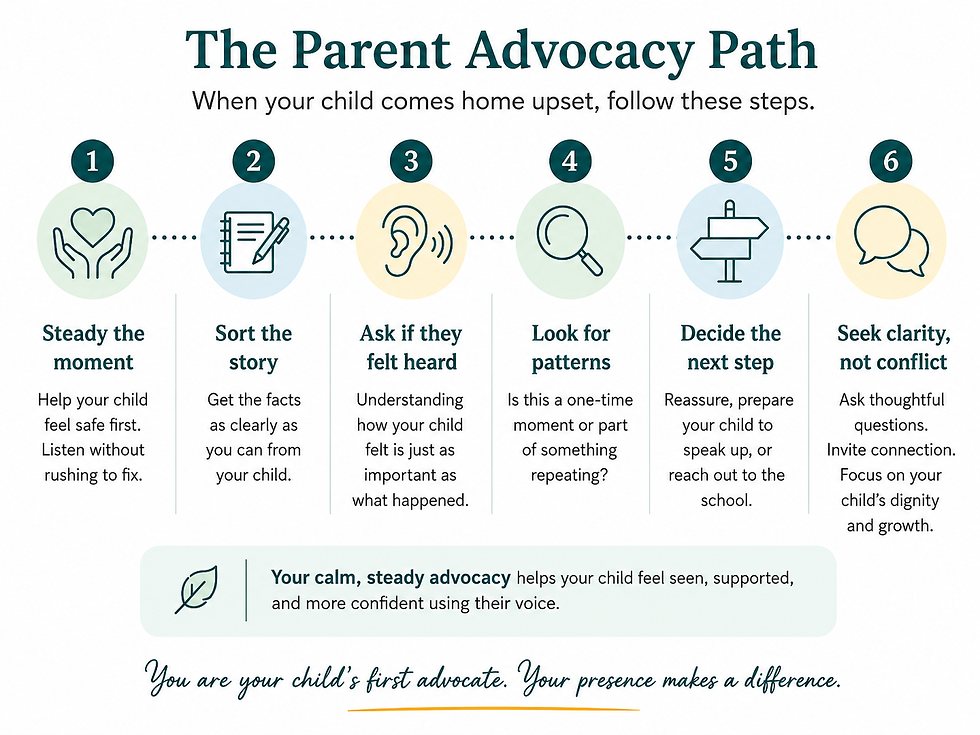
Start by slowing the moment down
When a child comes home upset, the first job is not to investigate like a lawyer. It is to help them feel steady enough to tell the story.
That sounds simple, but it is easy to skip. Adults often move quickly into questions. What happened? Who did that? Did you tell the teacher? Why didn’t you say something? What did you do? Those questions may be important later, but they can feel like a lot when a child is already upset.
A better first move is often something like: “I can see this really bothered you. Let’s slow it down and figure out what happened together.”
That kind of sentence does a few important things. It tells your child you are listening. It does not assume they are right about every detail. It does not assume the school is wrong. It creates enough space for the story to become clearer.
Children do not always have the full language for what happened. They may tell the story out of order. They may focus on the part that felt most unfair. They may leave out context, not because they are trying to mislead you, but because they are still making sense of it themselves. Slowing down helps for everyone.
Sort the story before you solve the problem
Once your child is calmer, try to separate the story into a few pieces.
What happened first?
What did the adults say or do?
What did your child say or do?
What was the final decision or outcome?
What part felt most upsetting to your child?
This is not about doubting your child. It is about helping them move from emotion toward understanding.
A child might say, “My teacher got mad at me for no reason.”
That may be exactly how it felt. But before a parent can advocate well, it helps to know more. Was there a direction your child did not understand? Was there a conflict with another student? Was your child corrected publicly? Were they given a chance to explain? Did they know what they were supposed to do next?
Ask whether your child felt heard
One of the most useful questions a parent can ask is not only, “What happened?” It is, “Did you feel like you had a chance to explain your side?”
This question matters because children can often accept limits more easily when they understand the process. Being heard does not mean they get their way. It does not mean the adult gives up authority. It does not mean every school decision becomes negotiable.
Being heard means the child had some access to explanation, participation, and dignity. They understood what happened and why. They had a developmentally appropriate chance to share their perspective. They were treated with respect, even if the answer was still no.
That is very different from a child simply being told the outcome after the fact.
Sometimes children are upset because they did not like the consequence. That is real, but it may not mean something went wrong. Other times, children are upset because they never understood the decision, never had a chance to speak, or felt shamed in the process. That is worth paying closer attention to.
Look for the difference between a hard moment and a pattern
Not every upsetting school moment requires advocacy. Children will have hard days. They will misunderstand directions. They will experience disappointment. They will navigate conflict with peers. They will sometimes be corrected by adults, and correction can feel uncomfortable even when it is appropriate.
The question is whether the situation appears to be isolated or part of a pattern.
A single hard day might call for reassurance, reflection, and perhaps a small follow-up. A pattern may need more direct advocacy.
Pay attention if your child repeatedly says things like, “No one listens to me,” “I never know why I’m in trouble,” “They always believe the other person,” “I don’t want to tell the teacher because it won’t matter,” or “I just stopped trying.”
Those kinds of statements may point to something deeper than one bad afternoon. They may suggest a gap in voice, explanation, safety, belonging, or dignity.
That does not automatically mean the school does not care. Schools are busy places. Teachers and administrators are often managing many needs at once, sometimes inside systems that do not make careful communication easy. But even when the cause is not lack of care, the impact on the child still matters.

Decide whether to contact the school
After you have listened, slowed the story down, and looked for patterns, you can decide whether school contact is needed.
Sometimes the best next step is to help your child prepare to speak to the teacher themselves. You might ask, “Would you like help thinking through what you could say tomorrow?” or “What would you want your teacher to understand about how that felt?” This builds your child’s capacity to use their voice respectfully.
Other times, especially with younger children or more serious concerns, parent contact is appropriate.
When reaching out, try to keep the first message calm, specific, and process-focused. For example:
“Hi [Teacher Name], my child came home upset about something that happened today. I’m still trying to understand the situation clearly. Would you be able to help me understand what happened, how the decision was made, and what support will be in place moving forward?”
That kind of message does not accuse. It opens a door. It also keeps the focus where it belongs: understanding, process, support, and next steps.
Helpful questions to ask the school
When you do contact the school, it can help to use questions that invite clarity rather than defensiveness.
You might ask how the decision was made, whether your child had an opportunity to share their perspective, how expectations were communicated, what support is in place now, what you might reinforce at home, and whether the school is noticing anything that would help you understand the bigger picture.
These questions help shift the conversation away from sides and toward shared understanding.
That matters because most parents and educators want the same broad thing. They want the child to be safe, supported, accountable, and able to learn.
The conversation goes better when everyone can stay connected to that shared ground.

What your child learns from how you respond
Children learn a lot from how adults respond to school concerns. If we dismiss them too quickly, they may learn their voice does not matter. If we rush in too aggressively, they may learn that advocacy means conflict. If we slow down, listen carefully, ask better questions, and seek understanding, they learn something more useful.
They learn that their feelings matter, but feelings are not the whole story. They learn that adults can hold concern and fairness at the same time. They learn that asking for clarity is not disrespectful. They learn that using their voice can be calm, thoughtful, and constructive. That is the heart of parent advocacy.
It is not about taking over every school problem. It is about helping children understand what happened, recognize when something felt wrong, and learn how to move forward with dignity.
A simple first step
The next time your child comes home upset about school, try starting here:
“I believe that this felt upsetting. Let’s slow it down and understand what happened.”
Then listen. Not to build a case. Not to dismiss. Not to rush. Listen so you can help your child move from confusion toward clarity.
Sometimes that will lead to a conversation at home. Sometimes it will lead to an email. Sometimes it will lead to a meeting. Sometimes it will simply help your child feel less alone.
But in every case, the message is the same: your voice matters, we will use it thoughtfully, and we will work toward understanding before we decide what comes next.
Next step
If your child has been coming home upset and you are unsure how to approach the school, start with the free guide, Helping Your Child Be Heard at School.
For a more structured way to prepare for a conversation, the Parent Advocacy Conversation Guide can help you organize what happened, what questions to ask, and what next step would be most constructive.


Comments