

Your child comes home upset, or you receive an email from school that leaves you with more questions than answers. A meeting gets booked. Before it happens, parents can feel pulled in two directions: you want to protect your child, and you also want a conversation with the school that actually helps.
In my work as an educator and principal, I’ve sat in many conversations with families where everyone cared about the same child but arrived with different pieces of the story. You don’t need to walk into that room with a perfect argument. You need enough clarity to explain what your child has shared, ask what you still don’t understand, and leave knowing what happens next.

Before the meeting, sort what you know
Sometimes a child tells you about a hard school day while they’re still upset, and you may only have one part of the story. The school may also be working from a partial picture. Slowing down before the meeting gives you room to separate three things: what you know, what your child felt or understood, and what you still need the school to clarify. Sorting the story doesn’t require you to doubt your child or assume the school is right. It simply keeps assumptions from hardening before everyone has had a chance to explain what they saw.
One thing I would listen for in the meeting is whether your child understood what happened, had a chance to explain their part, and knows what happens next. Those are concrete things you can ask about without turning the meeting into an argument over whose version is right. If you’re interested in thinking more about what rights like voice, dignity, and participation actually look like for children at school, I’ve written more about that in What Does a Right Actually Mean to a Child?.
Decide what you need from the conversation
Before the meeting, decide what you most need to understand or change. Are you looking for clarification about a decision? Support moving forward? Repair after a difficult interaction? A combination of those things? Choosing one main question can keep the meeting from becoming a review of every frustration your family has ever had with school. If you’re still working out how to raise a concern constructively, How to Advocate for Your Child at School Without Creating Conflict offers a broader starting point.
A simple preparation page can be surprisingly useful. Write down the one question you most need answered, what you want the school to understand about your child, what you hope will be clearer by the end of the conversation, and anything you don’t want to forget once the meeting starts. That is usually enough to keep you grounded when the conversation becomes emotional or complicated.
Bring your child’s perspective without making them carry the meeting
Before you go, ask your child what they want the adults to understand. You can also ask what felt unfair, confusing, or upsetting, what they wish had been explained better, and what would help school feel steadier tomorrow.
Younger children may answer with only a few words. Older students may want to attend part of the meeting or speak for themselves. Either way, their perspective can inform the conversation without requiring them to manage the adults around them.
Your child can be heard without being asked to carry adult responsibility. Adults still have to make decisions about safety, boundaries, support, and what happens next. Listening seriously to a child does not mean asking them to solve the situation themselves.
Start with questions that keep the conversation open
The first question can shape the tone of the meeting. Questions that ask for process and explanation give the school something concrete to respond to, while helping you understand whether your child had a chance to participate and what support is available now.
You don’t need to ask all of these. Pick the two or three that get closest to what you still don’t understand.
Can you help me understand how this decision was made?
Was my child given an opportunity to share their perspective?
How were expectations communicated before the issue came up?
What part of the situation do you think my child may still be confused about?
What support is in place moving forward?
Is there anything important I may not be seeing from the school side yet?
These questions leave room for information you may not have yet. They also give teachers and school leaders a better chance to explain what they were trying to do, which is especially useful when the experience your child describes and the experience the school describes don’t line up neatly.
If you disagree, stay specific
Parents can be firm without making the meeting combative. If you’re worried your child was singled out, opening with “Why was my child targeted?” can put everyone into defence before you have the full picture. A more workable starting point might be, “Can you help me understand how this was handled and what my child was told?” If you’re seeing a pattern, you can say, “I’m noticing this has come up more than once, and I’d like to understand what is happening across these situations.”
And sometimes you’ll hear an explanation and still feel that an important part of the concern hasn’t been addressed. You can say that too: “I understand what you’re explaining. I’m still unclear about what my child understood in the moment. Can we go back to that part?” Specific language gives everyone something concrete to respond to and gives you a clearer record if the concern continues.
Constructive advocacy doesn’t require you to agree with every explanation. You can say that a response doesn’t answer your concern, ask for a process to be explained again, request another meeting, or ask who the appropriate next person is when an issue remains unresolved. Keeping your language tied to the child, the process, and the evidence helps the conversation stay useful even when the disagreement is real.
Leave knowing what happens next
Before the meeting ends, slow down long enough to make the next step explicit. Ask what support will be in place, who is responsible for following up, when you should expect to hear back, what the school would like reinforced at home, and what your child will be told.
A simple way to do that is: “Can I make sure I have this right? What happens next, who is following up, and when should we check back in?” If there is a new plan, ask how everyone will know whether it is helping. Clear follow-up is especially important after an emotional conversation because people can leave the same meeting with very different understandings of what was agreed.
After the meeting, write it down
A short follow-up email can protect everyone from confusion. It can be as simple as: “Thank you for meeting today. My understanding is that we agreed to the following next steps…” Then list the few points you understood were decided and any question that still needs an answer. If the same concern continues over time, keep a simple record of dates, what happened, who was involved, what support was offered, and what changed afterward. Documentation helps you look for patterns instead of relying on memory during a stressful moment.
A useful meeting can still include disagreement
Families and schools won’t always see a situation the same way. A productive meeting doesn’t require complete agreement. What I would hope for is that the parent can bring the child’s experience clearly, the school can explain its own information and process, and everyone stays focused on what the child needs to understand and move forward.
If you’d like something beside you before, during, or after the meeting, the Parent Advocacy Conversation Guide includes preparation pages, conversation scripts, a meeting planner, a follow-up email builder, and a pattern tracker.
But you don’t need the download to use the approach in this article. Start with what you know. Name what you still need to understand. Bring your child’s perspective into the room. Ask clear questions. Leave with a next step you can actually follow.
For me, a useful school meeting doesn’t have to end in complete agreement. It should end with more clarity than it started with, a child whose experience has been taken seriously, and adults who know what happens next.
There are moments in school when the paperwork is done, the policy has been followed, the adult response can be justified, and still, the child in front of us has not really been served.
I think most educators know that feeling. It shows up in small ways at first. A student is struggling, and the conversation turns quickly to behaviour. A teacher is exhausted, and the answer becomes another initiative, another expectation, another system to manage. A parent raises a concern, and suddenly everyone starts speaking carefully, as though the language of school has become more important than the child’s experience of it.
That is the tension the book I'm writing, is trying to name.

I have spent more than two decades inside public education. I have seen extraordinary educators do deeply human work in systems that often make that work harder than it should be. I have seen schools protect students, open doors for students, and give children a place to belong. I have also seen students quietly diminished by routines, assumptions, labels, and policies that were never really built around who they are.
So this book did not begin from a distance. It began from classrooms, hallways, staff rooms, parent conversations, school meetings, and the quiet knowledge many people in education carry but don’t always feel free to say out loud.
We keep saying public education is here for students. I believe it should be. I still believe public education is one of the few places where children from different families, cultures, languages, identities, abilities, and experiences are meant to learn alongside one another. That is worth protecting. I haven’t written this book because I’ve given up on public education. I’ve written it because I haven’t.
But protecting public education cannot mean protecting every structure public education has inherited.
Some of those structures were built for efficiency. Some were built for sameness. Some were built to make large systems easier to manage. Some were built in another time, for another world, around a much narrower idea of the student. And now, many of those same structures are still shaping children who are growing up in a world that requires creativity, flexibility, collaboration, critical thought, and the ability to live well with difference.
That contradiction shows up everywhere once we start paying attention. It shows up when we call a quiet classroom successful without asking who feels safe enough to speak. It shows up when we treat the same consequence as fairness, even when the students involved are carrying entirely different histories, needs, and circumstances. It shows up when a child’s movement, intensity, sensitivity, or questioning is treated as something to correct before it is understood. It shows up when student voice is invited only after the adult decision has already been made.
This is where I think schools have to become more honest.
A student is not simply a behaviour to manage, a score to report, or a problem to solve. A student is a person with rights. That sounds simple, but in practice, it changes how we understand almost every part of school life.
If students are rights-bearing people, then dignity, safety, voice, and belonging cannot be treated as extras. They cannot be offered when learning is smooth and withdrawn when learning becomes difficult. They have to be built into the structure of school itself.
That does not remove adult authority. It does not mean students get whatever they want. It does not mean classrooms become chaotic or expectations disappear. It means the authority adults hold has to be used in service of students, not simply in service of order.
There is a difference between a school system that manages students and a school system that serves them. A system that manages students is usually asking, “How do we get this child to comply?” A system that serves students is asking, “What conditions does this child need in order to learn, participate, repair, belong, and grow?”
Those questions lead to very different schools.
I think many educators already know this. They feel it on the hard days. They feel it when a student’s behaviour finally makes sense after someone takes the time to learn the story underneath it. They feel it when a conflict that could have become a punishment becomes a conversation, an agreement, or a repair. They feel it when students are given enough structure to use their voice well, and the room becomes more grounded instead of less.
Those moments are small, but they are not minor. They show what school can become when the system is willing to learn.
That is really the heart of School the System. For a long time, we have focused on schooling children into the existing structure. We teach them how to line up, wait, produce, perform, meet the measure, and adapt. Some structure is necessary. Schools need routines. Communities need agreements. Children need limits, guidance, and adults who can hold steady when things become difficult.
But structure should serve students. When structure starts serving the system more than the child, we need to be honest enough to notice.
This book is trying to name the moment when compliance gets mistaken for learning. When sameness gets mistaken for fairness. When silence gets mistaken for respect. When a child is asked to become smaller so the system can remain unchanged.
I don’t think we change public education by pretending educators are not trying hard enough. Most of the educators I know are trying very hard. Many are carrying far more than the public sees. But care inside a strained system is not enough on its own. Good people can still be handed tools that don’t serve students well. Thoughtful leaders can still be pulled into decisions that protect process over people. Caring educators can still participate in patterns they would never have designed themselves.
That is why the system itself has to become part of the lesson.
If schools are truly here for students, then schools have to be willing to learn from students. Learn from the student who withdraws. Learn from the student who keeps getting sent out. Learn from the student who asks why. Learn from the student who does well on paper but feels invisible. Learn from the parent who senses something is wrong but does not yet have the language for it. Learn from the teacher who keeps saying, quietly, “This is not working.”
That is the work this book is trying to begin.
Not a finished answer. Not a perfect framework. Not another promise that schools can be transformed if everyone simply follows the steps. Something more honest than that.
A call to look carefully at what public education has inherited, what it still protects, and what students are asking us to become brave enough to change.
The first draft is finished. The work of refining it is just beginning. And maybe that feels fitting, because the book is asking of the system what writing is asking of me right now: revise what no longer serves, keep what is true, and be willing to learn from what is in front of you.
If this is the kind of school conversation you care about, I’ll be sharing more behind-the-book reflections through The Schooling Signal as School the System takes shape.
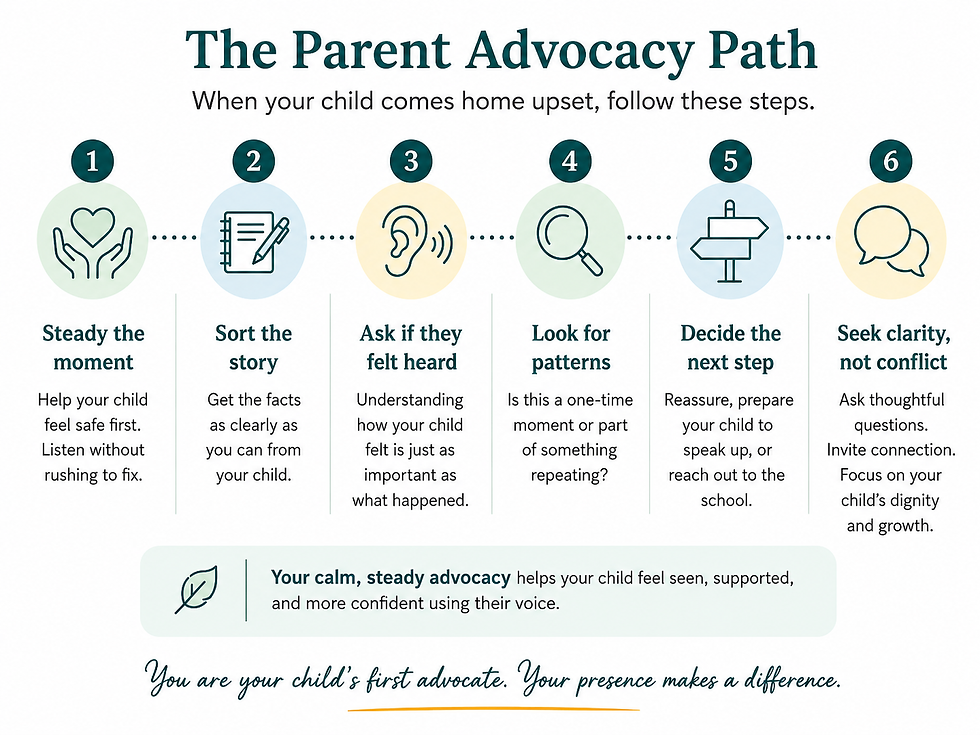
When your child comes home upset about something that happened at school, it can be hard to know what to do first.
Part of you wants to protect them immediately. Part of you wants to email the teacher before the backpack has even hit the floor. Part of you may wonder whether your child is telling you the whole story, whether the school handled it well, or whether this is one more moment in a pattern you have been trying to name for a while.

When a child is upset about school, they are often telling us more than the facts of one moment. They may be telling us they felt embarrassed, confused, dismissed, unsafe, left out, misunderstood, or powerless. Sometimes the issue is serious and needs immediate action. Sometimes it is a conflict that can be resolved with better communication. Sometimes it is simply a hard day.
The challenge for parents is sorting those possibilities without dismissing the child, blaming the school, or rushing into a conversation before the situation is clear.
This is where a calm first step is so key to a healthy school relationship.

Start by slowing the moment down
When a child comes home upset, the first job is not to investigate like a lawyer. It is to help them feel steady enough to tell the story.
That sounds simple, but it is easy to skip. Adults often move quickly into questions. What happened? Who did that? Did you tell the teacher? Why didn’t you say something? What did you do? Those questions may be important later, but they can feel like a lot when a child is already upset.
A better first move is often something like: “I can see this really bothered you. Let’s slow it down and figure out what happened together.”
That kind of sentence does a few important things. It tells your child you are listening. It does not assume they are right about every detail. It does not assume the school is wrong. It creates enough space for the story to become clearer.
Children do not always have the full language for what happened. They may tell the story out of order. They may focus on the part that felt most unfair. They may leave out context, not because they are trying to mislead you, but because they are still making sense of it themselves. Slowing down helps for everyone.
Sort the story before you solve the problem
Once your child is calmer, try to separate the story into a few pieces.
What happened first?
What did the adults say or do?
What did your child say or do?
What was the final decision or outcome?
What part felt most upsetting to your child?
This is not about doubting your child. It is about helping them move from emotion toward understanding.
A child might say, “My teacher got mad at me for no reason.”
That may be exactly how it felt. But before a parent can advocate well, it helps to know more. Was there a direction your child did not understand? Was there a conflict with another student? Was your child corrected publicly? Were they given a chance to explain? Did they know what they were supposed to do next?
Ask whether your child felt heard
One of the most useful questions a parent can ask is not only, “What happened?” It is, “Did you feel like you had a chance to explain your side?”
This question matters because children can often accept limits more easily when they understand the process. Being heard does not mean they get their way. It does not mean the adult gives up authority. It does not mean every school decision becomes negotiable.
Being heard means the child had some access to explanation, participation, and dignity. They understood what happened and why. They had a developmentally appropriate chance to share their perspective. They were treated with respect, even if the answer was still no.
That is very different from a child simply being told the outcome after the fact.
Sometimes children are upset because they did not like the consequence. That is real, but it may not mean something went wrong. Other times, children are upset because they never understood the decision, never had a chance to speak, or felt shamed in the process. That is worth paying closer attention to.
Look for the difference between a hard moment and a pattern
Not every upsetting school moment requires advocacy. Children will have hard days. They will misunderstand directions. They will experience disappointment. They will navigate conflict with peers. They will sometimes be corrected by adults, and correction can feel uncomfortable even when it is appropriate.
The question is whether the situation appears to be isolated or part of a pattern.
A single hard day might call for reassurance, reflection, and perhaps a small follow-up. A pattern may need more direct advocacy.
Pay attention if your child repeatedly says things like, “No one listens to me,” “I never know why I’m in trouble,” “They always believe the other person,” “I don’t want to tell the teacher because it won’t matter,” or “I just stopped trying.”
Those kinds of statements may point to something deeper than one bad afternoon. They may suggest a gap in voice, explanation, safety, belonging, or dignity.
That does not automatically mean the school does not care. Schools are busy places. Teachers and administrators are often managing many needs at once, sometimes inside systems that do not make careful communication easy. But even when the cause is not lack of care, the impact on the child still matters.

Decide whether to contact the school
After you have listened, slowed the story down, and looked for patterns, you can decide whether school contact is needed.
Sometimes the best next step is to help your child prepare to speak to the teacher themselves. You might ask, “Would you like help thinking through what you could say tomorrow?” or “What would you want your teacher to understand about how that felt?” This builds your child’s capacity to use their voice respectfully.
Other times, especially with younger children or more serious concerns, parent contact is appropriate.
When reaching out, try to keep the first message calm, specific, and process-focused. For example:
“Hi [Teacher Name], my child came home upset about something that happened today. I’m still trying to understand the situation clearly. Would you be able to help me understand what happened, how the decision was made, and what support will be in place moving forward?”
That kind of message does not accuse. It opens a door. It also keeps the focus where it belongs: understanding, process, support, and next steps.
Helpful questions to ask the school
When you do contact the school, it can help to use questions that invite clarity rather than defensiveness.
You might ask how the decision was made, whether your child had an opportunity to share their perspective, how expectations were communicated, what support is in place now, what you might reinforce at home, and whether the school is noticing anything that would help you understand the bigger picture.
These questions help shift the conversation away from sides and toward shared understanding.
That matters because most parents and educators want the same broad thing. They want the child to be safe, supported, accountable, and able to learn.
The conversation goes better when everyone can stay connected to that shared ground.

What your child learns from how you respond
Children learn a lot from how adults respond to school concerns. If we dismiss them too quickly, they may learn their voice does not matter. If we rush in too aggressively, they may learn that advocacy means conflict. If we slow down, listen carefully, ask better questions, and seek understanding, they learn something more useful.
They learn that their feelings matter, but feelings are not the whole story. They learn that adults can hold concern and fairness at the same time. They learn that asking for clarity is not disrespectful. They learn that using their voice can be calm, thoughtful, and constructive. That is the heart of parent advocacy.
It is not about taking over every school problem. It is about helping children understand what happened, recognize when something felt wrong, and learn how to move forward with dignity.
A simple first step
The next time your child comes home upset about school, try starting here:
“I believe that this felt upsetting. Let’s slow it down and understand what happened.”
Then listen. Not to build a case. Not to dismiss. Not to rush. Listen so you can help your child move from confusion toward clarity.
Sometimes that will lead to a conversation at home. Sometimes it will lead to an email. Sometimes it will lead to a meeting. Sometimes it will simply help your child feel less alone.
But in every case, the message is the same: your voice matters, we will use it thoughtfully, and we will work toward understanding before we decide what comes next.
Next step
If your child has been coming home upset and you are unsure how to approach the school, start with the free guide, Helping Your Child Be Heard at School.
For a more structured way to prepare for a conversation, the Parent Advocacy Conversation Guide can help you organize what happened, what questions to ask, and what next step would be most constructive.