
Parents: Before You Contact the School, Read This

Updated: May 1
A calmer way to prepare for hard school conversations when something about your child’s experience does not feel right.
Sometimes you know something is off before you know exactly what to call it. Your child comes home upset, quieter than usual, or suddenly resistant to going back the next day. You ask what happened and get fragments instead of a full picture. A comment. A consequence. A confusing interaction. Enough to know something landed hard, but not always enough to know what to do next.

That is often the moment when parents feel pressure to act fast. And sometimes acting fast makes sense. But often, the more useful first move is to slow the situation down just enough to get clear. Not because your concern is not real. Because clearer advocacy usually works better. The deeper problem in these moments is often not a lack of care or concern. It is that everyone is reacting before the situation has been understood well enough to respond thoughtfully.
What it actually means for a child to be heard
When parents say they want their child to be heard, that can be misunderstood as a request for special treatment. It is not. A child being heard means they have access to explanation, participation, and dignity. They deserve to understand what happened and why. They deserve a developmentally appropriate chance to share their perspective. And they deserve to be treated with respect, even when limits are firm and adult decisions remain in place. Schools still require structure. Teachers still make final decisions. What matters is process. When children experience explanation and participation, they are more likely to feel respected and regulated. When they experience confusion or silence, it often shows up later as frustration, withdrawal, or resistance.
Many school concerns are framed too quickly as behaviour issues or compliance problems. Sometimes that framing fits. Sometimes it misses something important.
Sometimes the deeper issue is not that a child was corrected. It is that they were left confused, shut out of the process, or spoken about as if their perspective did not matter. When that happens, what looks like a discipline issue on the surface may actually be a gap in voice.
Why this work includes parents too
This is one reason parent-facing advocacy work matters. A healthier school culture is not built by educators alone. It is built when schools and families share a clearer language for voice, dignity, participation, and responsibility. A democratic school culture depends on adults creating systems where children are included, in age-appropriate ways, in the decisions that shape their school experience. Parents are part of that learning community, not outsiders who only show up when something has gone wrong.
That matters even more because schools are complex places. Teachers and school leaders are often trying to do good work inside systems shaped by policies, time pressures, limited resources, and institutional habits that do not always handle hard moments well. Parents feel that strain from one side. Educators feel it from the other. The point is not to turn families and schools into opposing camps. It is to help both sides move toward more clarity, less defensiveness, and a better process for the child in the middle.
And if we are honest, many parents are trying to navigate those moments while also carrying incomplete information, school language that feels unfamiliar, and the pressure of wanting to protect their child without making the situation worse. That is why this kind of work exists. Not to hand parents a script for conflict, but to help them walk into difficult conversations with more steadiness, better questions, and a stronger sense of what their child needs adults to understand. Parents who understand this process are better able to recognize when something has been missed, engage more constructively, and help their child build confidence in speaking thoughtfully and respectfully.

Before you reach out, slow the moment down
Once you see yourself as part of that learning community, the next step is not to rush in louder. It is to slow the situation down enough to see it more clearly.
Before you contact the school, it helps to ask a better first question. Not only, “What went wrong?” but also, “What is still unclear here?”
What does your child actually understand about what happened? Do they know what decision was made? Do they know why it was made? Do they feel they had any chance to explain themselves? Were expectations clear before the moment, or only after it?
This is such an important shift because many parents reach out while still holding only part of the picture. That is understandable. It is also where conversations can become more reactive than useful. The real concern gets buried. The emotional temperature rises. Everyone starts defending their role instead of building understanding. Often what children need first is not immediate intervention, but understanding. Slowing the situation down at home can help you decide whether advocacy is needed and how to approach it thoughtfully.
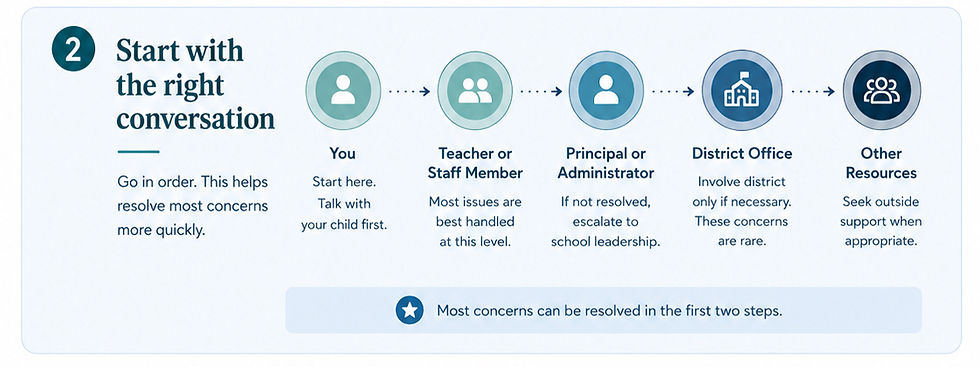
Questions worth asking first
A more grounded first step is to sort out what you know, what your child knows, and what still needs to be clarified. What facts do you actually have right now? What does your child most want adults to understand? Are you asking for clarity, support, repair, or some combination of the three?
Once you do reach out, strong first questions often sound more like this: How was this decision made? Was my child given an opportunity to share their perspective? How were expectations communicated? What support will be in place moving forward? Those are not weak questions. They are focused questions. They do not abandon standards or structure. They simply insist that process matters. Reframing a situation as a possible gap in voice rather than a conflict of sides creates more room for collaboration and usually leads to a better conversation.

Before you contact the school, it can help to slow the situation down and work through a few grounding questions first. This kind of preparation can help you separate facts from assumptions, clarify what your child most needs adults to understand, and enter the conversation with more steadiness.
A calmer first step is still a strong one
Parents do not need perfect language. They need enough clarity to avoid making a hard moment harder.
Some of the most useful advocacy work happens before the email is sent or the meeting is booked. It happens in the pause. In the sorting. In asking what your child understands, what still feels confusing, what you are really asking for, and what a helpful next step might look like.
If you start there, the conversation is more likely to protect what matters most. Not special treatment, but explanation, participation, and dignity. Not panic, but preparation. Not a fight for the sake of fighting, but a clearer path toward being heard.
If something about your child’s school experience feels unsettled, you do not need to carry that alone and you do not need to rush into the next conversation without support. Children are best served when parents and educators are not forced into opposite corners, but are working from a stronger shared language around voice, dignity, and participation. A better process helps everyone involved, but especially the child at the centre of it.


If you want the fuller support behind this page, the Parent Advocacy Conversation Guide was created to help parents prepare for these conversations with more clarity, less panic, and a stronger sense of what their child needs adults to understand.


Comments