

I recently had the opportunity to join Dr. Sheldon Eakins for a conversation on his platform, and I’m genuinely grateful for it.
It is always energizing to sit down with someone who is asking serious questions about education, not just how schools run, but who they are really serving, what discipline is actually doing, and whether our systems are helping young people grow or simply asking them to comply. That is part of what made this conversation feel so worthwhile. The episode is now live as “Why Everything You Know About School Discipline is WRONG!” on YouTube and in the Leading Equity podcast feed.
Watch or Listen to the Conversation
Watch the full conversation here, or open the episode in your preferred podcast app.
In our conversation, we explored school discipline, blanket policies, student voice, and the importance of moving beyond exclusionary responses that often say more about adult systems than they do about the needs of the child in front of us. We also talked about some of the ideas behind my Web of Rights work, especially the belief that schools should be communities built with students, not systems imposed onto them.
One of the ideas that came through strongly for me is this: consistency is not always the same thing as fairness.
In many schools, discipline policies are written broadly so they can be applied uniformly. On paper, that can look clear and efficient. In practice, it can flatten context, ignore identity, and miss the real needs behind behaviour. That is a problem. A school cannot claim to care about equity while refusing to consider the lived reality of the students it serves.
We also talked about the difference between facilitation and control.
I believe deeply that educators have experience, responsibility, and an important role in helping children navigate conflict. But that is not the same thing as dictating every agreement from above. A healthy classroom is not a dictatorship. It is a community. It is a place where students learn that rights matter, that other people’s rights matter too, and that conflict is something we can work through with structure, honesty, and care.
That kind of work is not always easy. It asks a lot of educators. It asks us to reflect on our own instincts, to question policies that may be convenient for adults but harmful for students, and to stay grounded in integrity when systems make that difficult. But I think that is part of the vocation of education. If we are here to serve students, then our structures, our discipline approaches, and our relationships all need to reflect that.
I appreciated the chance to explore these ideas with Sheldon because his work is clearly rooted in helping educators think more deeply about belonging, leadership, school culture, and what it means to create student-centred learning environments. Through Purposeful Teaching Academy, his services for schools and leaders, and his broader writing and speaking, he continues to create space for conversations that matter.
If this conversation resonates with you, I encourage you to check out the full episode and spend some time with Sheldon’s work as well.
You can watch the conversation on YouTube, and you can find the episode in the Leading Equity podcast feed on Apple Podcasts. Sheldon’s current work can be found through Purposeful Teaching Academy, and educators or school leaders interested in workshops, coaching, or consulting can start on his services page or contact page.
He also has several books worth exploring, including Meaningful Classroom Management, which ASCD has listed under his author profile, and What Are You Bringing to the Potluck?, available through Solution Tree. A Wiley listing also continues to carry Leading Equity: Becoming an Advocate for All Students.
I’m thankful to Sheldon for the invitation and for the chance to talk with someone clearly committed to supporting educators who want to build schools that are more thoughtful, more just, and more human.
Some of the richest learning in a school day can look, from a distance, like children are wasting time.
A group of students building something that keeps falling over. A child testing what happens when a leaf, a rock, and a stick hit a puddle. A recess game that works for five minutes, breaks down, gets renegotiated, and somehow becomes better than the first version. None of that fits neatly into a worksheet. None of it is especially quiet. It can look messy, loud, inefficient, and hard to measure.
That may be exactly why schools should pay closer attention to it.
Children reveal a great deal through play. They show us how they solve problems, how they handle disappointment, how they use power, how they respond to boundaries, how they include others, and how they recover when a plan falls apart. They test ideas with their hands before they can always explain them with language. They rehearse social life before they fully understand the rules of it.
When schools treat play as a prize for finishing the “real” work, we shrink one of the most honest places children have to practise being learners, community members, and full people.

Play gives us information
Adults often say children learn through play when they are very young. Then, as children move through school, we begin replacing that language with words like focus, productivity, readiness, and achievement.
Those words are useful in the right places. Classrooms need purpose. Teachers work within real time constraints. Students need explicit instruction, practice, feedback, and structure. I have no interest in pretending school can run on imagination alone.
And yet, I worry about what gets lost when play is treated as something separate from serious learning.
A child dropping objects into a puddle is not simply making a mess. They are investigating. A group building a fort is working through design, balance, space, cooperation, frustration, and revision. Students inventing a game are dealing with rules, fairness, leadership, exclusion, persuasion, disappointment, and shared responsibility.
If adults want to understand how students think, play gives us evidence. It shows us what students try first, what they notice, how they adapt, and where they get stuck. It also shows us what the classroom community has already taught them about power, voice, fairness, and repair.
Play has rights inside it
In my work with the Web of Rights, play has always been one of the clearest places to see how rights connect.
A child has a right to play. A child also has a right to safety. A child has a right to identity, including preferences, comfort levels, and ways of participating. A child has a right to be heard when something stops feeling safe, fair, or enjoyable.
Those rights can meet inside one ordinary playground game.
One student may love chasing games. Another may want to join without being touched. Another may be bigger, faster, louder, or more confident, and may not realize how their body or energy is affecting the group. Another may keep saying yes because they want to belong, even though their face, posture, or silence is telling a different story.
That is where adult facilitation becomes necessary. The answer cannot always be to shut the game down and move on. It also cannot be to call it free play and hope students figure it out alone.
Students need language for the hard parts of play. They need to know how to say stop, how to hear stop, how to adjust the rules, how to notice when someone has gone quiet, how to repair after harm, and how to create agreements that allow more than one child’s rights to be protected at the same time.

A classroom example
Imagine a group of students playing a rough chasing game outside. At first, everyone seems excited. There is running, laughing, shouting, and quick rule-making. Then the energy shifts. One student grabs another student too hard. Someone says they were only joking. Someone else says they do not want to play anymore. Another student argues that the game is ruined if everyone keeps changing the rules.
A familiar adult response might be, “That’s enough. The game is over.”
Sometimes that response is necessary for immediate safety. Adults have to protect students. There are moments when a clear stop is the right move. The learning cannot end there.
Once students are regulated, the adult can bring the group back to the rights involved. Who wanted to play? Who needed safety? Who needed personal space? Who needed a clearer agreement? Who was trying to belong but did not know how to name discomfort? What rule would make the game safe enough to try again?
That conversation teaches far more than a simple ban on the game. It gives students a way to understand what happened without reducing the whole situation to one child being “bad” or one child being “too sensitive.” It also keeps the adult’s role clear. The adult protects safety, holds the boundary, and helps students build the language and agreement they did not have yet.

Play teaches limits
One reason play can be uncomfortable for adults is that it exposes unfinished learning very quickly.
Students argue over rules. They test each other. They misread tone. They push too hard. They exclude without always understanding what they are doing. They use humour that lands badly. They struggle to let someone else lead. They get frustrated when their idea is rejected.
That can make play feel risky in a busy school day. I understand why adults sometimes want to control it, shorten it, or remove the parts that create conflict.
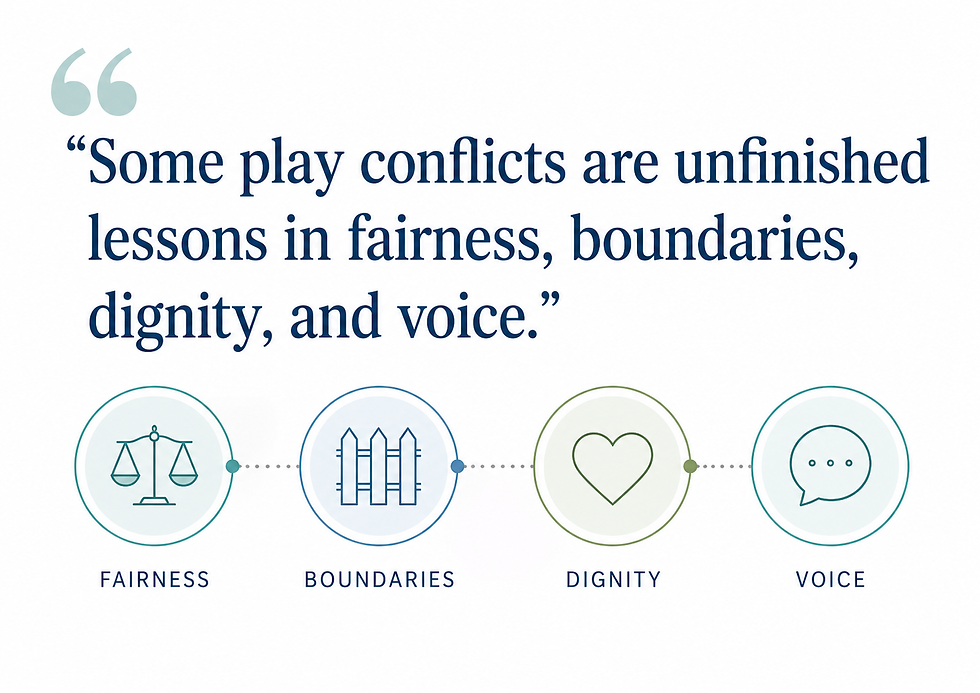
But many of those conflicts are showing us the exact skills students still need.
A student who keeps changing the rules may need help understanding fairness and shared agreement. A student who dominates the game may need help noticing impact. A student who walks away silently may need language for boundaries. A student who laughs after someone says stop may need direct teaching around consent and dignity.
Play gives adults a living context for this teaching. It gives students a real reason to learn the language because the language belongs to something they care about. The goal is to keep the community safe enough for children to practise.
What educators can try
This does not require a complete redesign of the school day. It can begin with small adult moves that help students connect play to responsibility.
After a game breaks down, ask students what part of the game worked before asking who ruined it. When students argue over rules, slow the group down long enough to name the agreement they thought they had. When a child says stop, treat that language as a skill to be respected, then teach the group how to respond. When play becomes unsafe, stop it clearly, then return to the learning once the group can think again.
One useful question is:
What agreement would help everyone keep playing safely?
That question gives students something practical to build. It keeps the adult anchored in safety while inviting students into shared responsibility. It also teaches children that rules should protect people, rather than simply serve adult control.
Over time, students begin to carry that language with them. They start saying, “I need space,” “That rule does not feel fair,” “Can we change the game?” or “I want to play, but I do not want to be tagged that way.” Those are small signs of a stronger learning community. They show students beginning to understand that their own rights are connected to the rights of the people around them.

What this asks of schools
If schools are serious about student voice, dignity, and belonging, play cannot sit at the edge of the conversation.
Play is one of the first places children practise voice. It is one of the first places they test fairness. It is one of the first places they learn whether adults will help them solve conflict or simply remove the conflict from view.
I do not think we need more romantic language about childhood while the actual school day gives children fewer chances to move, imagine, negotiate, and make choices. We need school communities willing to protect play with the same seriousness they bring to curriculum planning, behaviour expectations, and assessment.
That requires structure. It requires adult attention. It requires clear boundaries. It requires a willingness to teach through the messy parts rather than treating messiness as proof that play has failed.
Children learn a great deal from what adults protect. If we protect only quiet, speed, compliance, and completed tasks, students will learn what kind of person school rewards. If we also protect curiosity, movement, negotiation, consent, repair, and shared joy, students receive a fuller education.
Where to go next
If you are an educator, the next step is to make this practical. The free Web of Rights Starter Guide introduces the classroom language behind rights, safety, play, identity, and shared responsibility.
If you want a more structured classroom rollout, the Web of Rights Implementation Planner includes scripts, prompts, reflection pages, and activities for teaching rights, safety, boundaries, consent, negotiation, and repair.
If you are a parent reading this because your child keeps coming home feeling unheard, start with Helping Your Child Be Heard at School. It gives families a calmer way to think about explanation, participation, dignity, and next steps.
What does a government move quickly to protect?
That question sits underneath a lot of public conversations about education, even when nobody says it out loud. We hear there is no room, no flexibility, no capacity. We are told to be realistic. We are told systems are under pressure and hard choices have to be made. But then we watch hundreds of millions appear when the priority is industry, optics, or economic urgency, and suddenly the limits do not seem quite so fixed after all.
That is part of what I mean when I say, kids, not cars.
This is not really about cars. It is about priorities. It is about what a society reveals when it decides what deserves urgency, protection, and investment. If Ontario can absorb the writing off of $445 million in old Chrysler debt, while school systems are expected to normalize deficits in the tens of millions, then we are no longer just talking about budgets. We are talking about values. We are talking about what gets framed as essential, and what gets treated as something that should simply learn to do more with less.
Education is a service industry. It is built on relationships, support, human capacity, and care. The work is not abstract. The work is people. It is young people arriving at school with needs, strengths, fears, questions, identities, and a right to be taken seriously. It is educators trying to create spaces where learning, belonging, and growth can actually happen. And yet when education is under strain, the language shifts quickly. We start hearing about restraint, efficiency, control, and limitation. Students start sounding less like the reason the system exists and more like a problem the system is struggling to carry.
That shift should make all of us uncomfortable.
Students are not numbers on a spreadsheet. They are not a line item to be managed down. They are not an inconvenience to adult systems. They are young people with rights, voices, and futures, and the quality of their school experience is shaped by every decision a system makes about what matters most. When funding pressure shows up, it does not stay trapped inside a report or a boardroom slide deck. It shows up in classrooms. It shows up in support staff stretched thinner. It shows up in fewer interventions, fewer relationships, less capacity, and less room to respond well when students need schools to be places of steadiness and care.
This is why I keep coming back to the idea that public education is a public good. Not in a vague or nostalgic sense, but in a practical one. Schools are where children learn how to live with other people. They are where students test their voice, build identity, experience fairness or unfairness, and begin to understand what it means to belong to a community. If we say that matters, then our decisions should reflect it. If we say children matter, then the systems around them should be built in ways that prove it.
That does not mean schools do not need accountability. It does not mean every financial reality disappears. It does mean we should be honest about the cost of our choices. When education is treated as a place to absorb pressure while other sectors receive speed, flexibility, and protection, children carry that strain. So do the adults working closest to them. And once that becomes normal, we risk accepting a version of schooling that is more concerned with managing scarcity than serving students well.
For me, this connects directly to the broader work of student rights. A rights-informed approach asks us to look past convenience and ask harder questions. Who is being served by this decision? Who is carrying the burden of it? What does dignity look like here? What does meaningful support look like here? What would it mean to build schools that are not just efficient, but humane?
Because that is the deeper issue.
It is a challenge. It pushes us to ask whether our public systems still remember who they are for. It reminds us that the success of education cannot be measured only by what a system can cut, contain, or control. It has to be measured by whether children are known, supported, heard, and given real conditions to learn.
If we believe public education matters, then we have to stop talking about students as though they are too expensive to care for properly. We have to stop treating school communities as the place where every strain gets downloaded. We have to stop confusing endurance with investment.
Kids, not cars.
If our decisions say otherwise, then we should be honest enough to admit what our priorities really are.