
Play Is Not a Reward. It Is a Right

Updated: Apr 30
Some of the richest learning in a school day can look, from a distance, like children are wasting time.
A group of students building something that keeps falling over. A child testing what happens when a leaf, a rock, and a stick hit a puddle. A recess game that works for five minutes, breaks down, gets renegotiated, and somehow becomes better than the first version. None of that fits neatly into a worksheet. None of it is especially quiet. It can look messy, loud, inefficient, and hard to measure.
That may be exactly why schools should pay closer attention to it.
Children reveal a great deal through play. They show us how they solve problems, how they handle disappointment, how they use power, how they respond to boundaries, how they include others, and how they recover when a plan falls apart. They test ideas with their hands before they can always explain them with language. They rehearse social life before they fully understand the rules of it.
When schools treat play as a prize for finishing the “real” work, we shrink one of the most honest places children have to practise being learners, community members, and full people.

Play gives us information
Adults often say children learn through play when they are very young. Then, as children move through school, we begin replacing that language with words like focus, productivity, readiness, and achievement.
Those words are useful in the right places. Classrooms need purpose. Teachers work within real time constraints. Students need explicit instruction, practice, feedback, and structure. I have no interest in pretending school can run on imagination alone.
And yet, I worry about what gets lost when play is treated as something separate from serious learning.
A child dropping objects into a puddle is not simply making a mess. They are investigating. A group building a fort is working through design, balance, space, cooperation, frustration, and revision. Students inventing a game are dealing with rules, fairness, leadership, exclusion, persuasion, disappointment, and shared responsibility.
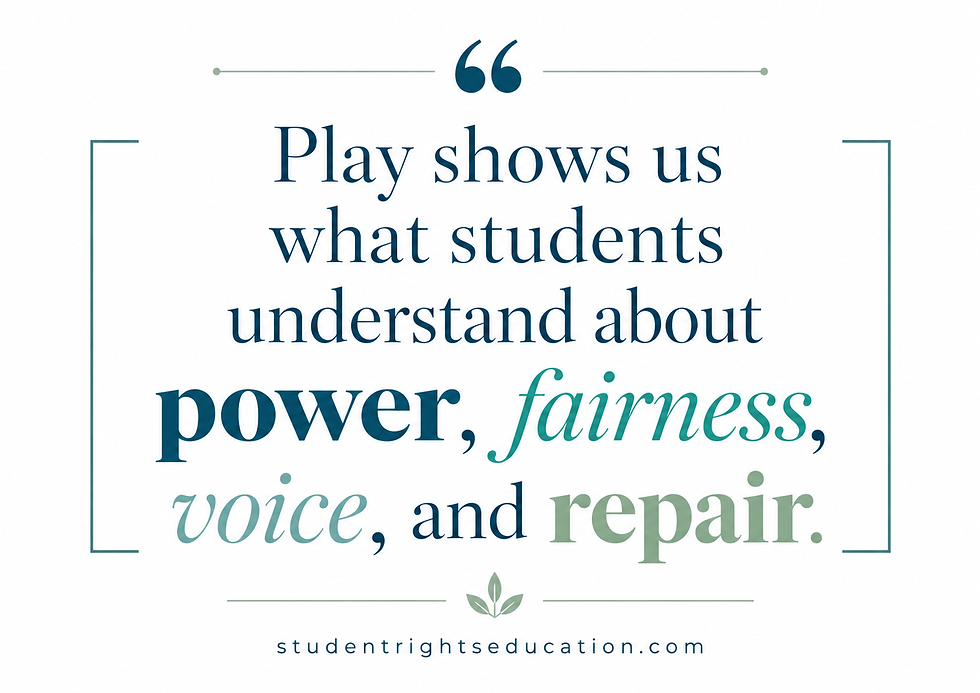
If adults want to understand how students think, play gives us evidence. It shows us what students try first, what they notice, how they adapt, and where they get stuck. It also shows us what the classroom community has already taught them about power, voice, fairness, and repair.
Play has rights inside it
In my work with the Web of Rights, play has always been one of the clearest places to see how rights connect.
A child has a right to play. A child also has a right to safety. A child has a right to identity, including preferences, comfort levels, and ways of participating. A child has a right to be heard when something stops feeling safe, fair, or enjoyable.
Those rights can meet inside one ordinary playground game.
One student may love chasing games. Another may want to join without being touched. Another may be bigger, faster, louder, or more confident, and may not realize how their body or energy is affecting the group. Another may keep saying yes because they want to belong, even though their face, posture, or silence is telling a different story.
That is where adult facilitation becomes necessary. The answer cannot always be to shut the game down and move on. It also cannot be to call it free play and hope students figure it out alone.
Students need language for the hard parts of play. They need to know how to say stop, how to hear stop, how to adjust the rules, how to notice when someone has gone quiet, how to repair after harm, and how to create agreements that allow more than one child’s rights to be protected at the same time.

A classroom example
Imagine a group of students playing a rough chasing game outside. At first, everyone seems excited. There is running, laughing, shouting, and quick rule-making. Then the energy shifts. One student grabs another student too hard. Someone says they were only joking. Someone else says they do not want to play anymore. Another student argues that the game is ruined if everyone keeps changing the rules.
A familiar adult response might be, “That’s enough. The game is over.”
Sometimes that response is necessary for immediate safety. Adults have to protect students. There are moments when a clear stop is the right move. The learning cannot end there.
Once students are regulated, the adult can bring the group back to the rights involved. Who wanted to play? Who needed safety? Who needed personal space? Who needed a clearer agreement? Who was trying to belong but did not know how to name discomfort? What rule would make the game safe enough to try again?
That conversation teaches far more than a simple ban on the game. It gives students a way to understand what happened without reducing the whole situation to one child being “bad” or one child being “too sensitive.” It also keeps the adult’s role clear. The adult protects safety, holds the boundary, and helps students build the language and agreement they did not have yet.

Play teaches limits
One reason play can be uncomfortable for adults is that it exposes unfinished learning very quickly.
Students argue over rules. They test each other. They misread tone. They push too hard. They exclude without always understanding what they are doing. They use humour that lands badly. They struggle to let someone else lead. They get frustrated when their idea is rejected.
That can make play feel risky in a busy school day. I understand why adults sometimes want to control it, shorten it, or remove the parts that create conflict.
But many of those conflicts are showing us the exact skills students still need.
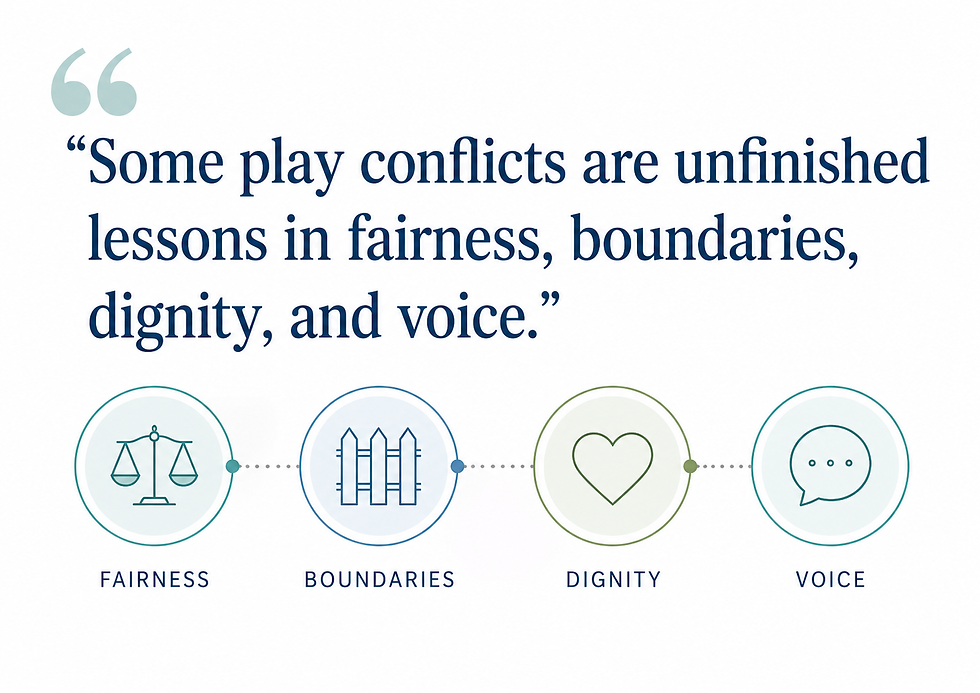
A student who keeps changing the rules may need help understanding fairness and shared agreement. A student who dominates the game may need help noticing impact. A student who walks away silently may need language for boundaries. A student who laughs after someone says stop may need direct teaching around consent and dignity.
Play gives adults a living context for this teaching. It gives students a real reason to learn the language because the language belongs to something they care about. The goal is to keep the community safe enough for children to practise.
What educators can try
This does not require a complete redesign of the school day. It can begin with small adult moves that help students connect play to responsibility.
After a game breaks down, ask students what part of the game worked before asking who ruined it. When students argue over rules, slow the group down long enough to name the agreement they thought they had. When a child says stop, treat that language as a skill to be respected, then teach the group how to respond. When play becomes unsafe, stop it clearly, then return to the learning once the group can think again.
One useful question is:
What agreement would help everyone keep playing safely?
That question gives students something practical to build. It keeps the adult anchored in safety while inviting students into shared responsibility. It also teaches children that rules should protect people, rather than simply serve adult control.
Over time, students begin to carry that language with them. They start saying, “I need space,” “That rule does not feel fair,” “Can we change the game?” or “I want to play, but I do not want to be tagged that way.” Those are small signs of a stronger learning community. They show students beginning to understand that their own rights are connected to the rights of the people around them.

What this asks of schools
If schools are serious about student voice, dignity, and belonging, play cannot sit at the edge of the conversation.
Play is one of the first places children practise voice. It is one of the first places they test fairness. It is one of the first places they learn whether adults will help them solve conflict or simply remove the conflict from view.
I do not think we need more romantic language about childhood while the actual school day gives children fewer chances to move, imagine, negotiate, and make choices. We need school communities willing to protect play with the same seriousness they bring to curriculum planning, behaviour expectations, and assessment.
That requires structure. It requires adult attention. It requires clear boundaries. It requires a willingness to teach through the messy parts rather than treating messiness as proof that play has failed.
Children learn a great deal from what adults protect. If we protect only quiet, speed, compliance, and completed tasks, students will learn what kind of person school rewards. If we also protect curiosity, movement, negotiation, consent, repair, and shared joy, students receive a fuller education.
Where to go next
If you are an educator, the next step is to make this practical. The free Web of Rights Starter Guide introduces the classroom language behind rights, safety, play, identity, and shared responsibility.
If you want a more structured classroom rollout, the Web of Rights Implementation Planner includes scripts, prompts, reflection pages, and activities for teaching rights, safety, boundaries, consent, negotiation, and repair.
If you are a parent reading this because your child keeps coming home feeling unheard, start with Helping Your Child Be Heard at School. It gives families a calmer way to think about explanation, participation, dignity, and next steps.


Comments