

There are moments in school when the paperwork is done, the policy has been followed, the adult response can be justified, and still, the child in front of us has not really been served.
I think most educators know that feeling. It shows up in small ways at first. A student is struggling, and the conversation turns quickly to behaviour. A teacher is exhausted, and the answer becomes another initiative, another expectation, another system to manage. A parent raises a concern, and suddenly everyone starts speaking carefully, as though the language of school has become more important than the child’s experience of it.
That is the tension the book I'm writing, is trying to name.

I have spent more than two decades inside public education. I have seen extraordinary educators do deeply human work in systems that often make that work harder than it should be. I have seen schools protect students, open doors for students, and give children a place to belong. I have also seen students quietly diminished by routines, assumptions, labels, and policies that were never really built around who they are.
So this book did not begin from a distance. It began from classrooms, hallways, staff rooms, parent conversations, school meetings, and the quiet knowledge many people in education carry but don’t always feel free to say out loud.
We keep saying public education is here for students. I believe it should be. I still believe public education is one of the few places where children from different families, cultures, languages, identities, abilities, and experiences are meant to learn alongside one another. That is worth protecting. I haven’t written this book because I’ve given up on public education. I’ve written it because I haven’t.
But protecting public education cannot mean protecting every structure public education has inherited.
Some of those structures were built for efficiency. Some were built for sameness. Some were built to make large systems easier to manage. Some were built in another time, for another world, around a much narrower idea of the student. And now, many of those same structures are still shaping children who are growing up in a world that requires creativity, flexibility, collaboration, critical thought, and the ability to live well with difference.
That contradiction shows up everywhere once we start paying attention. It shows up when we call a quiet classroom successful without asking who feels safe enough to speak. It shows up when we treat the same consequence as fairness, even when the students involved are carrying entirely different histories, needs, and circumstances. It shows up when a child’s movement, intensity, sensitivity, or questioning is treated as something to correct before it is understood. It shows up when student voice is invited only after the adult decision has already been made.
This is where I think schools have to become more honest.
A student is not simply a behaviour to manage, a score to report, or a problem to solve. A student is a person with rights. That sounds simple, but in practice, it changes how we understand almost every part of school life.
If students are rights-bearing people, then dignity, safety, voice, and belonging cannot be treated as extras. They cannot be offered when learning is smooth and withdrawn when learning becomes difficult. They have to be built into the structure of school itself.
That does not remove adult authority. It does not mean students get whatever they want. It does not mean classrooms become chaotic or expectations disappear. It means the authority adults hold has to be used in service of students, not simply in service of order.
There is a difference between a school system that manages students and a school system that serves them. A system that manages students is usually asking, “How do we get this child to comply?” A system that serves students is asking, “What conditions does this child need in order to learn, participate, repair, belong, and grow?”
Those questions lead to very different schools.
I think many educators already know this. They feel it on the hard days. They feel it when a student’s behaviour finally makes sense after someone takes the time to learn the story underneath it. They feel it when a conflict that could have become a punishment becomes a conversation, an agreement, or a repair. They feel it when students are given enough structure to use their voice well, and the room becomes more grounded instead of less.
Those moments are small, but they are not minor. They show what school can become when the system is willing to learn.
That is really the heart of School the System. For a long time, we have focused on schooling children into the existing structure. We teach them how to line up, wait, produce, perform, meet the measure, and adapt. Some structure is necessary. Schools need routines. Communities need agreements. Children need limits, guidance, and adults who can hold steady when things become difficult.
But structure should serve students. When structure starts serving the system more than the child, we need to be honest enough to notice.
This book is trying to name the moment when compliance gets mistaken for learning. When sameness gets mistaken for fairness. When silence gets mistaken for respect. When a child is asked to become smaller so the system can remain unchanged.
I don’t think we change public education by pretending educators are not trying hard enough. Most of the educators I know are trying very hard. Many are carrying far more than the public sees. But care inside a strained system is not enough on its own. Good people can still be handed tools that don’t serve students well. Thoughtful leaders can still be pulled into decisions that protect process over people. Caring educators can still participate in patterns they would never have designed themselves.
That is why the system itself has to become part of the lesson.
If schools are truly here for students, then schools have to be willing to learn from students. Learn from the student who withdraws. Learn from the student who keeps getting sent out. Learn from the student who asks why. Learn from the student who does well on paper but feels invisible. Learn from the parent who senses something is wrong but does not yet have the language for it. Learn from the teacher who keeps saying, quietly, “This is not working.”
That is the work this book is trying to begin.
Not a finished answer. Not a perfect framework. Not another promise that schools can be transformed if everyone simply follows the steps. Something more honest than that.
A call to look carefully at what public education has inherited, what it still protects, and what students are asking us to become brave enough to change.
The first draft is finished. The work of refining it is just beginning. And maybe that feels fitting, because the book is asking of the system what writing is asking of me right now: revise what no longer serves, keep what is true, and be willing to learn from what is in front of you.
If this is the kind of school conversation you care about, I’ll be sharing more behind-the-book reflections through The Schooling Signal as School the System takes shape.
Ask most children what a rule is and they can usually give you an answer pretty quickly. Don’t run in the hallway. Raise your hand. Keep your hands to yourself. Wait your turn. Rules are familiar territory in school because children hear them all day long.
Ask the same group what a right is and the answers tend to get a little more interesting.

Some children will describe something they are allowed to do. Some will talk about fairness. Others will name something they want. Younger children often connect the idea of rights to things that feel very personal to them, like their favourite game, their family, their body, or the things they like and do not like.
That is actually a useful place to begin.
Before children can understand how rights connect, how one person’s rights can come into tension with someone else’s, or why communities need agreements, they need a simple understanding of what a right is in the first place. In the Web of Rights, I usually begin with a straightforward idea: a right is something every person deserves because they are a person.
That sounds simple, but it changes the way we talk to children about school.
A child does not earn the right to feel safe by behaving well. They do not earn dignity by completing their work. They do not lose the right to be heard because they made a poor choice. There may still be boundaries, consequences, routines, and adult decisions. Schools need structure. But rights do not switch on and off depending on whether a child is being compliant.
I think that is where some of the confusion begins. Children are often very familiar with privileges because schools use them all the time. Computer time might depend on expectations. A preferred activity might depend on the circumstances of the day. A teacher may decide where students sit or when certain things happen. Those decisions can change.
A child’s dignity should not.
When I first began exploring rights with young children, I found that identity was often one of the easiest ways into the conversation. A child understands that I cannot tell them what their favourite colour is. I cannot tell them their favourite food is hummus because mine is. They know that preference belongs to them. From there, the thinking can stretch. Their body belongs to them. Their feelings and identity are part of who they are. They deserve to feel safe. They deserve to be treated with respect.
And then comes the harder part: so does everyone else.
That is the beginning of the Web.
Teaching rights is not about telling children, “You have rights, so you get to do whatever you want.” A student can have the right to express an opinion and still hear no. They can have the right to play and still encounter limits around where, when, or how that play happens. They can disagree with an adult while the adult remains responsible for making the final decision.
What they are learning is that some things about being a person deserve protection even when adults are setting limits.
This is why I would not begin with a long lesson or a complicated definition. I would start with conversation.
What is something every person in this room deserves? Should everyone feel safe here? Should people be able to say when something is bothering them? Should people still be treated respectfully when they make a mistake?
I would also ask whether the teacher has rights.
That question is important because a rights-informed classroom is not built around children on one side and adults on the other. Everyone is part of the same community. The teacher has the right to feel safe. The student beside you has the right to learn. The child across the room has the right to be heard. You have those rights too.
Once children begin to understand that, the conversation starts to move away from “What am I allowed to do?” and toward something much more useful: “How do we live together when all of us have rights?”
That is where the real learning starts.
I would keep the first conversation small. There is no need to turn this into a giant unit on day one. If students leave understanding one idea clearly, that is enough: I have rights because I am a person, and so does everyone else.
Then use that language again when the classroom gets real.
Use it when someone interrupts. Use it when a child needs space. Use it when two students disagree about a game. Use it when you have to say no and want students to understand why.
The Web of Rights becomes useful when rights stop being something students learned about and start becoming language they use to understand the life they are already living together.
Want to Introduce This in Your Classroom?
If this feels like a useful place to begin, the free Web of Rights Starter Guide takes the next step. It includes foundational rights language, classroom examples, and discussion prompts designed to help students begin thinking about safety, dignity, voice, and shared responsibility.
Or, if you want to understand the framework before bringing it into your classroom, you can explore the Web of Rights here →
Some of the richest learning in a school day can look, from a distance, like children are wasting time.
A group of students building something that keeps falling over. A child testing what happens when a leaf, a rock, and a stick hit a puddle. A recess game that works for five minutes, breaks down, gets renegotiated, and somehow becomes better than the first version. None of that fits neatly into a worksheet. None of it is especially quiet. It can look messy, loud, inefficient, and hard to measure.
That may be exactly why schools should pay closer attention to it.
Children reveal a great deal through play. They show us how they solve problems, how they handle disappointment, how they use power, how they respond to boundaries, how they include others, and how they recover when a plan falls apart. They test ideas with their hands before they can always explain them with language. They rehearse social life before they fully understand the rules of it.
When schools treat play as a prize for finishing the “real” work, we shrink one of the most honest places children have to practise being learners, community members, and full people.

Play gives us information
Adults often say children learn through play when they are very young. Then, as children move through school, we begin replacing that language with words like focus, productivity, readiness, and achievement.
Those words are useful in the right places. Classrooms need purpose. Teachers work within real time constraints. Students need explicit instruction, practice, feedback, and structure. I have no interest in pretending school can run on imagination alone.
And yet, I worry about what gets lost when play is treated as something separate from serious learning.
A child dropping objects into a puddle is not simply making a mess. They are investigating. A group building a fort is working through design, balance, space, cooperation, frustration, and revision. Students inventing a game are dealing with rules, fairness, leadership, exclusion, persuasion, disappointment, and shared responsibility.
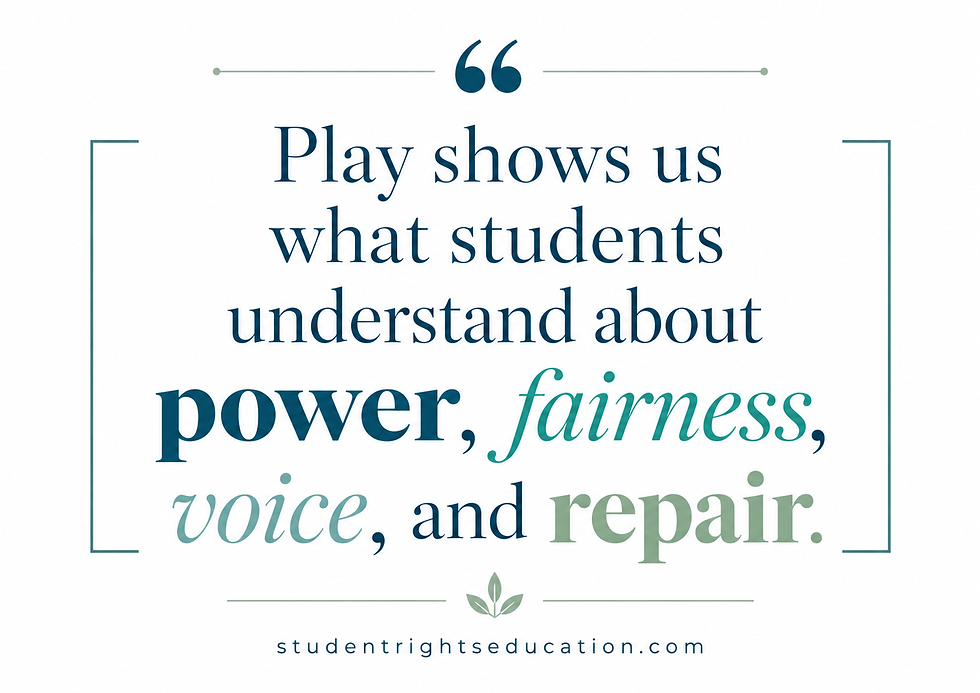
If adults want to understand how students think, play gives us evidence. It shows us what students try first, what they notice, how they adapt, and where they get stuck. It also shows us what the classroom community has already taught them about power, voice, fairness, and repair.
Play has rights inside it
In my work with the Web of Rights, play has always been one of the clearest places to see how rights connect.
A child has a right to play. A child also has a right to safety. A child has a right to identity, including preferences, comfort levels, and ways of participating. A child has a right to be heard when something stops feeling safe, fair, or enjoyable.
Those rights can meet inside one ordinary playground game.
One student may love chasing games. Another may want to join without being touched. Another may be bigger, faster, louder, or more confident, and may not realize how their body or energy is affecting the group. Another may keep saying yes because they want to belong, even though their face, posture, or silence is telling a different story.
That is where adult facilitation becomes necessary. The answer cannot always be to shut the game down and move on. It also cannot be to call it free play and hope students figure it out alone.
Students need language for the hard parts of play. They need to know how to say stop, how to hear stop, how to adjust the rules, how to notice when someone has gone quiet, how to repair after harm, and how to create agreements that allow more than one child’s rights to be protected at the same time.

A classroom example
Imagine a group of students playing a rough chasing game outside. At first, everyone seems excited. There is running, laughing, shouting, and quick rule-making. Then the energy shifts. One student grabs another student too hard. Someone says they were only joking. Someone else says they do not want to play anymore. Another student argues that the game is ruined if everyone keeps changing the rules.
A familiar adult response might be, “That’s enough. The game is over.”
Sometimes that response is necessary for immediate safety. Adults have to protect students. There are moments when a clear stop is the right move. The learning cannot end there.
Once students are regulated, the adult can bring the group back to the rights involved. Who wanted to play? Who needed safety? Who needed personal space? Who needed a clearer agreement? Who was trying to belong but did not know how to name discomfort? What rule would make the game safe enough to try again?
That conversation teaches far more than a simple ban on the game. It gives students a way to understand what happened without reducing the whole situation to one child being “bad” or one child being “too sensitive.” It also keeps the adult’s role clear. The adult protects safety, holds the boundary, and helps students build the language and agreement they did not have yet.

Play teaches limits
One reason play can be uncomfortable for adults is that it exposes unfinished learning very quickly.
Students argue over rules. They test each other. They misread tone. They push too hard. They exclude without always understanding what they are doing. They use humour that lands badly. They struggle to let someone else lead. They get frustrated when their idea is rejected.
That can make play feel risky in a busy school day. I understand why adults sometimes want to control it, shorten it, or remove the parts that create conflict.
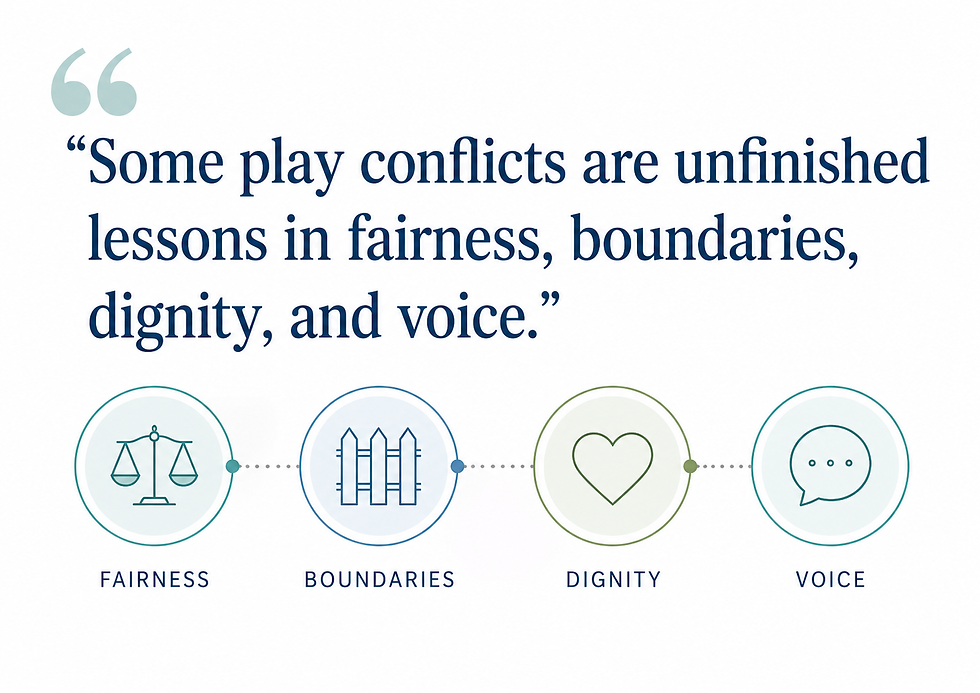
But many of those conflicts are showing us the exact skills students still need.
A student who keeps changing the rules may need help understanding fairness and shared agreement. A student who dominates the game may need help noticing impact. A student who walks away silently may need language for boundaries. A student who laughs after someone says stop may need direct teaching around consent and dignity.
Play gives adults a living context for this teaching. It gives students a real reason to learn the language because the language belongs to something they care about. The goal is to keep the community safe enough for children to practise.
What educators can try
This does not require a complete redesign of the school day. It can begin with small adult moves that help students connect play to responsibility.
After a game breaks down, ask students what part of the game worked before asking who ruined it. When students argue over rules, slow the group down long enough to name the agreement they thought they had. When a child says stop, treat that language as a skill to be respected, then teach the group how to respond. When play becomes unsafe, stop it clearly, then return to the learning once the group can think again.
One useful question is:
What agreement would help everyone keep playing safely?
That question gives students something practical to build. It keeps the adult anchored in safety while inviting students into shared responsibility. It also teaches children that rules should protect people, rather than simply serve adult control.
Over time, students begin to carry that language with them. They start saying, “I need space,” “That rule does not feel fair,” “Can we change the game?” or “I want to play, but I do not want to be tagged that way.” Those are small signs of a stronger learning community. They show students beginning to understand that their own rights are connected to the rights of the people around them.

What this asks of schools
If schools are serious about student voice, dignity, and belonging, play cannot sit at the edge of the conversation.
Play is one of the first places children practise voice. It is one of the first places they test fairness. It is one of the first places they learn whether adults will help them solve conflict or simply remove the conflict from view.
I do not think we need more romantic language about childhood while the actual school day gives children fewer chances to move, imagine, negotiate, and make choices. We need school communities willing to protect play with the same seriousness they bring to curriculum planning, behaviour expectations, and assessment.
That requires structure. It requires adult attention. It requires clear boundaries. It requires a willingness to teach through the messy parts rather than treating messiness as proof that play has failed.
Children learn a great deal from what adults protect. If we protect only quiet, speed, compliance, and completed tasks, students will learn what kind of person school rewards. If we also protect curiosity, movement, negotiation, consent, repair, and shared joy, students receive a fuller education.
Where to go next
If you are an educator, the next step is to make this practical. The free Web of Rights Starter Guide introduces the classroom language behind rights, safety, play, identity, and shared responsibility.
If you want a more structured classroom rollout, the Web of Rights Implementation Planner includes scripts, prompts, reflection pages, and activities for teaching rights, safety, boundaries, consent, negotiation, and repair.
If you are a parent reading this because your child keeps coming home feeling unheard, start with Helping Your Child Be Heard at School. It gives families a calmer way to think about explanation, participation, dignity, and next steps.



)-2.png)


