


A school can genuinely believe in outdoor learning and still make it surprisingly difficult for teachers to get outside. Most educators I know do not need another presentation convincing them that children benefit from opportunities to move, explore, notice, wonder and learn beyond four walls. Many already want to create more of those opportunities. Whether the school around them makes that work possible is a separate question.
If taking a class outside regularly means that an individual teacher has to independently navigate supervision, weather, accessibility, equipment, schedules, curriculum expectations, risk procedures and the needs of thirty different learners, outdoor learning can quickly become something we value in principle but struggle to sustain in practice. At that point, motivation is only part of the picture. The conditions around the teacher are doing a lot of the work too.

Research into outdoor learning in Canadian schools has been pointing in this direction for some time. Educator confidence and experience are part of the picture alongside principal support, school and district policies, funding, resources, curriculum expectations, schedules, school culture and the physical environment.[1]
More recent Canadian research examining how outdoor learning can be expanded across public education continues to identify institutional and process-based barriers and emphasizes the need to involve educators, administrators and policy-makers when thinking about implementation at scale.[2]
We can have teachers who believe deeply in outdoor learning and still place them inside structures that make it difficult to do.
I have seen this pattern with plenty of good ideas in schools. Usually, someone gets excited. They try something, learn through experience, collect supplies, solve problems, figure out what works and become the person everybody else asks. That kind of leadership helps schools move forward because educators are willing to experiment, learn and share what they discover.
The challenge is what happens next. If outdoor learning disappears when that teacher changes grades, moves schools, takes a leave or simply no longer has the capacity to carry it, then outdoor learning was never fully built into the school. We benefited from an enthusiastic educator.
Those educators are still essential. The work becomes more sustainable when the conditions around them make it easier for others to join, adapt and continue. Leadership has work to do here.
Before asking teachers to do more, make the work easier to carry
Teachers are already making hundreds of decisions every day. They are thinking about individual student needs, transitions, supervision, assessment, family communication, behaviour, safety, curriculum and everything unexpected that walks through the classroom door before 9:00 a.m. Then we tell them outdoor learning is valuable and encourage them to do more of it.
That encouragement can be completely sincere while still leaving a teacher thinking, “Okay, but how?” Leadership can help answer that question by looking closely at the conditions around the work instead of adding another initiative or another binder.
Are expectations around taking students outside clear? Do teachers understand which spaces they can use and how they can use them? Does everyone have to create their own weather plan? Is there basic equipment available somewhere, or does outdoor learning depend on what individual teachers have bought, borrowed or collected? Have staff had opportunities to think about accessibility, sensory needs and participation outdoors? When a teacher has a reasonable question about supervision or risk, is there somewhere clear to take it? Are educators given opportunities to learn from colleagues who already have experience teaching outside?
At the board or system level, there is another layer to consider. Are policies helping educators use outdoor spaces thoughtfully, or unintentionally adding enough uncertainty that staying inside becomes the easier choice?
None of these questions are especially glamorous, but they shape whether teachers can actually do the work. In practice, sustainability often comes from ordinary decisions that reduce friction. A shared set of expectations can save twenty teachers from independently trying to interpret the same issue. A small collection of communal equipment can remove another obstacle. Time for an experienced teacher to work alongside a colleague can build confidence far more effectively than another reminder to get outside. A clear answer to a question about risk can turn “I’m not sure we’re allowed to do that” into “Okay, we can make this work.”
Take Me Outside’s strategic plan takes that wider view. Their work includes supporting educators who are curious about outdoor learning, building communities of educators already doing the work, and collaborating with school-system administrators to better understand and remove barriers.[3] That systems-level focus is useful because there is a limit to how far any educational practice can spread when its success depends on individual people repeatedly overcoming the same obstacles.
Teachers will always bring creativity, courage and initiative to schools. Schools benefit from that leadership. Good systems do something with what those educators learn. They make the path clearer for the next person, share resources, clarify expectations, notice unnecessary barriers, create opportunities for people to learn from each other, and make participation possible for more students and more educators.
Over time, outdoor learning becomes part of the school rather than something associated with a few particular teachers.
Outdoor learning does not become sustainable because every teacher suddenly becomes an outdoor-learning expert. It becomes more sustainable when teachers no longer have to figure out every part of it alone.
Structure is what makes participation possible outdoors
Sometimes when we talk about outdoor learning, the picture becomes very romantic. Students are exploring, moving, playing, noticing, wondering and learning in a more open environment. Those things can absolutely happen. So can conflict, uncertainty, competing needs and a child yelling from across the field, “He says I can’t go there!” The classroom community comes outside with us.
That tension helps clarify what structure is for. It should protect safety and participation without closing down the possibilities of being outside.
Outside, some of the assumptions of the classroom disappear. Students start asking different questions. Can we run here? Can I climb that? How far can I go? What if I do not want to participate in this activity? What if someone wants rough play and I do not want to be touched? What happens when one person’s exploration affects someone else’s safety?
Adults still hold responsibility for safety. There are decisions in schools that students cannot and should not be expected to carry. But there is a great deal of room between adults deciding everything and students deciding everything, and that space is where meaningful student voice can live.
A class can talk together about what people need to feel safe in a space, where someone might need room, how boundaries will be communicated, what respectful play looks like, which areas are open for exploration and what happens when an agreement stops working. When students help build the agreements that shape their learning community, a boundary can become something that protects another person’s ability to participate rather than simply another instruction from an adult. A conversation about safety can include responsibility. A disagreement can become an opportunity to practise listening, negotiation and repair.
That is still structure. It is simply structure with a purpose.
At the classroom level, that might look like shared agreements. At the school level, it might mean common expectations for outdoor spaces. At the system level, it can mean policies that give educators enough clarity to make thoughtful professional decisions. Across all three levels, the structure should make participation and safety easier without creating so much friction that the easiest option is always to stay inside.
Sustainability is also an equity question
This becomes an equity issue too. When outdoor learning relies on one educator’s confidence, personal collection of supplies, knowledge of risk procedures or ability to solve every logistical problem, access becomes uneven. Some students happen to land in classrooms where outdoor learning is part of the culture. Others may rarely experience it at all.
Recent Canadian research makes this scaling question explicit. Outdoor learning remains far from systematically implemented across public education, and researchers have argued that expanding access requires participation across multiple levels, including students, families, educators, administrators, policy-makers and community organizations.[2] Equitable access cannot be built by asking individual teachers to solve system-level problems one classroom at a time.
Equity will look different from school to school and child to child. Students bring different mobility, sensory, communication and support needs into outdoor spaces just as they do indoors. Schools themselves have different grounds, neighbourhoods, resources and access to green space. Making room for outdoor learning means building enough flexibility and support that educators can respond thoughtfully to those differences instead of treating them as reasons not to begin.
A sustainable system does not standardize the experience. It makes participation possible for more people.
The schoolyard can show us things the classroom sometimes misses
A change in environment can change what becomes visible to us. The student who rarely speaks during a whole-class discussion may suddenly have something to contribute outside. A child who struggles to sit still through a long lesson may become deeply engaged when movement is part of the learning. Students may notice things adults did not anticipate, use a space differently than we imagined or identify a boundary or problem we had not considered.
None of that means every outdoor experience will be peaceful, easy or transformative. Research into school-led nature interventions is encouraging, but it is also a good reminder not to make sweeping promises. A 2024 systematic review of 19 studies found some evidence of benefits in areas including positive affect, physical activity and social relationships or interactions, while also noting that the evidence base is still developing.[4]
That is a useful way for schools to approach this work. Outdoor learning can be worthwhile without being asked to solve every problem in education. We can value the possibilities it creates without turning it into another cure-all.
Those possibilities need to be available often enough for educators and students to learn from them. A practice cannot become part of school culture if every attempt at it feels like starting from zero.
A simple sustainability test
There is a simple question I would use when thinking about outdoor learning in a school: If the teacher who currently takes students outside most often left tomorrow, what would remain?
Would other staff still know how to use the spaces? Would expectations still be clear? Would people know where the resources were? Would teachers know where to take reasonable questions about supervision or risk? Would students still have opportunities to help shape how outdoor spaces are used? Would learning outside still appear in conversations about teaching and learning?
A string of no answers simply shows where the next work is.
The next move might be clearer guidance, shared equipment, time to learn alongside a colleague who already feels comfortable outside, or a staff conversation that reveals everyone has been operating under a rule that is not actually a rule. Students might need to be part of creating common outdoor agreements. None of those changes is dramatic on its own, but school improvement is often built through exactly these kinds of small structural decisions.
School leaders can help without becoming outdoor-learning experts themselves. They can listen to the educators already doing the work, ask what keeps getting in the way, make expectations clearer, create space for people to learn from one another, involve students in shaping the communities they learn in and remove unnecessary friction when they find it.
There will always be teachers who lead the way, and schools benefit from their experience.
Leadership can help turn what those teachers have learned into something colleagues can use and continue.
Making room is the work
We spend a lot of time asking whether teachers are ready to take learning outside. We could ask the system the same question: Is it ready to support the educators who want to?
Making room for outdoor learning still involves structure and clear expectations. The work is to look honestly at whether our schedules, policies, resources, professional learning and everyday leadership decisions make the practice easier to sustain or harder than it needs to be.
A practice that depends on extraordinary persistence is fragile. It becomes easier to sustain when the system learns from the people already doing the work and removes some of the obstacles around them.
Later this October, I’ll be carrying this question into conversations with school-system leaders at Take Me Outside’s Outdoor Learning Leadership Conference in Banff, where the focus includes embedding outdoor learning into policy, strategic planning, operations, professional learning and system-wide practice.[5] The conversation I want to have is about what can change around educators so that their interest in outdoor learning has somewhere to go.
Outdoor learning becomes more sustainable when getting outside stops requiring exceptional effort from a few people and becomes an ordinary possibility for more teachers and students.
What can we change inside the system that would make going outside easier?
References
[1] Oberle, E., Zeni, M., Munday, F., & Brussoni, M. (2021). Support Factors and Barriers for Outdoor Learning in Elementary Schools: A Systemic Perspective. American Journal of Health Education, 52(5), 251–265. https://doi.org/10.1080/19325037.2021.1955232
[2] Simpson, E., Donison, L., Zeni, M., de Lannoy, L., Matheson, K., Buxton, R., & Halsall, T. (2026). Applying Diverse Participatory Approaches to Co-Produce Research Impacts Within Outdoor Learning. International Journal of Qualitative Methods, 25. https://doi.org/10.1177/16094069261457199
[3] Take Me Outside. (2025). Strategic Plan 2025–2027. https://takemeoutside.ca/strategic-plan/
[4] Ly, V., & Vella-Brodrick, D. A. (2024). Effects of School-led Greenspace Interventions on Mental, Physical and Social Wellbeing in Children and Adolescents: A Systematic Review. Educational Psychology Review, 36, 133. https://doi.org/10.1007/s10648-024-09963-1
[5] Take Me Outside. (2026). Outdoor Learning Leadership Conference. https://takemeoutside.ca/leadership-conference/
Some of the richest learning in a school day can look, from a distance, like children are wasting time.
A group of students building something that keeps falling over. A child testing what happens when a leaf, a rock, and a stick hit a puddle. A recess game that works for five minutes, breaks down, gets renegotiated, and somehow becomes better than the first version. None of that fits neatly into a worksheet. None of it is especially quiet. It can look messy, loud, inefficient, and hard to measure.
That may be exactly why schools should pay closer attention to it.
Children reveal a great deal through play. They show us how they solve problems, how they handle disappointment, how they use power, how they respond to boundaries, how they include others, and how they recover when a plan falls apart. They test ideas with their hands before they can always explain them with language. They rehearse social life before they fully understand the rules of it.
When schools treat play as a prize for finishing the “real” work, we shrink one of the most honest places children have to practise being learners, community members, and full people.

Play gives us information
Adults often say children learn through play when they are very young. Then, as children move through school, we begin replacing that language with words like focus, productivity, readiness, and achievement.
Those words are useful in the right places. Classrooms need purpose. Teachers work within real time constraints. Students need explicit instruction, practice, feedback, and structure. I have no interest in pretending school can run on imagination alone.
And yet, I worry about what gets lost when play is treated as something separate from serious learning.
A child dropping objects into a puddle is not simply making a mess. They are investigating. A group building a fort is working through design, balance, space, cooperation, frustration, and revision. Students inventing a game are dealing with rules, fairness, leadership, exclusion, persuasion, disappointment, and shared responsibility.
If adults want to understand how students think, play gives us evidence. It shows us what students try first, what they notice, how they adapt, and where they get stuck. It also shows us what the classroom community has already taught them about power, voice, fairness, and repair.
Play has rights inside it
In my work with the Web of Rights, play has always been one of the clearest places to see how rights connect.
A child has a right to play. A child also has a right to safety. A child has a right to identity, including preferences, comfort levels, and ways of participating. A child has a right to be heard when something stops feeling safe, fair, or enjoyable.
Those rights can meet inside one ordinary playground game.
One student may love chasing games. Another may want to join without being touched. Another may be bigger, faster, louder, or more confident, and may not realize how their body or energy is affecting the group. Another may keep saying yes because they want to belong, even though their face, posture, or silence is telling a different story.
That is where adult facilitation becomes necessary. The answer cannot always be to shut the game down and move on. It also cannot be to call it free play and hope students figure it out alone.
Students need language for the hard parts of play. They need to know how to say stop, how to hear stop, how to adjust the rules, how to notice when someone has gone quiet, how to repair after harm, and how to create agreements that allow more than one child’s rights to be protected at the same time.

A classroom example
Imagine a group of students playing a rough chasing game outside. At first, everyone seems excited. There is running, laughing, shouting, and quick rule-making. Then the energy shifts. One student grabs another student too hard. Someone says they were only joking. Someone else says they do not want to play anymore. Another student argues that the game is ruined if everyone keeps changing the rules.
A familiar adult response might be, “That’s enough. The game is over.”
Sometimes that response is necessary for immediate safety. Adults have to protect students. There are moments when a clear stop is the right move. The learning cannot end there.
Once students are regulated, the adult can bring the group back to the rights involved. Who wanted to play? Who needed safety? Who needed personal space? Who needed a clearer agreement? Who was trying to belong but did not know how to name discomfort? What rule would make the game safe enough to try again?
That conversation teaches far more than a simple ban on the game. It gives students a way to understand what happened without reducing the whole situation to one child being “bad” or one child being “too sensitive.” It also keeps the adult’s role clear. The adult protects safety, holds the boundary, and helps students build the language and agreement they did not have yet.

Play teaches limits
One reason play can be uncomfortable for adults is that it exposes unfinished learning very quickly.
Students argue over rules. They test each other. They misread tone. They push too hard. They exclude without always understanding what they are doing. They use humour that lands badly. They struggle to let someone else lead. They get frustrated when their idea is rejected.
That can make play feel risky in a busy school day. I understand why adults sometimes want to control it, shorten it, or remove the parts that create conflict.
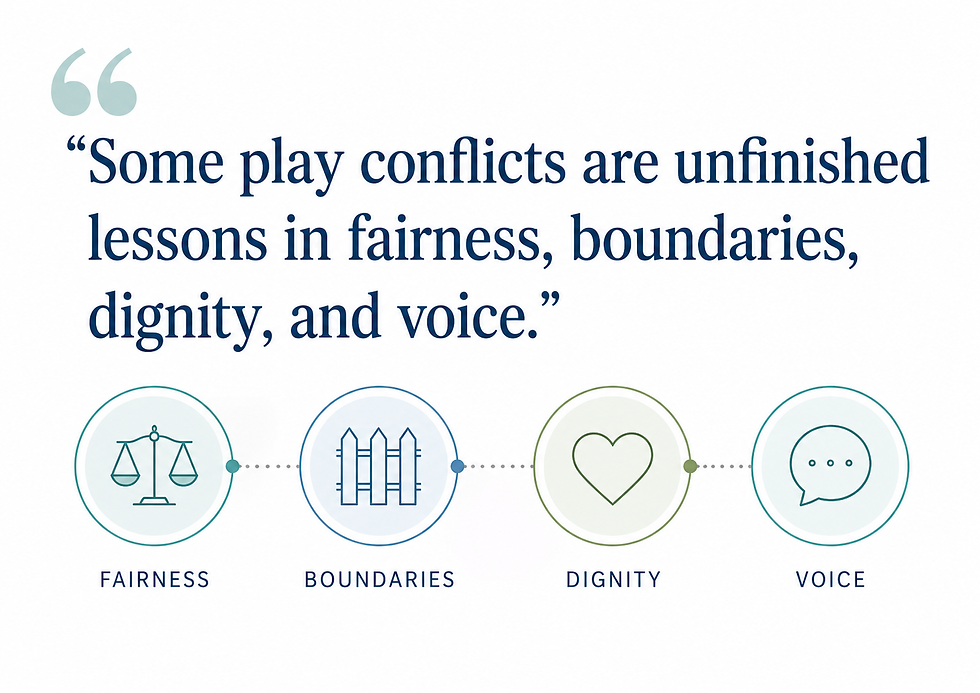
But many of those conflicts are showing us the exact skills students still need.
A student who keeps changing the rules may need help understanding fairness and shared agreement. A student who dominates the game may need help noticing impact. A student who walks away silently may need language for boundaries. A student who laughs after someone says stop may need direct teaching around consent and dignity.
Play gives adults a living context for this teaching. It gives students a real reason to learn the language because the language belongs to something they care about. The goal is to keep the community safe enough for children to practise.
What educators can try
This does not require a complete redesign of the school day. It can begin with small adult moves that help students connect play to responsibility.
After a game breaks down, ask students what part of the game worked before asking who ruined it. When students argue over rules, slow the group down long enough to name the agreement they thought they had. When a child says stop, treat that language as a skill to be respected, then teach the group how to respond. When play becomes unsafe, stop it clearly, then return to the learning once the group can think again.
One useful question is:
What agreement would help everyone keep playing safely?
That question gives students something practical to build. It keeps the adult anchored in safety while inviting students into shared responsibility. It also teaches children that rules should protect people, rather than simply serve adult control.
Over time, students begin to carry that language with them. They start saying, “I need space,” “That rule does not feel fair,” “Can we change the game?” or “I want to play, but I do not want to be tagged that way.” Those are small signs of a stronger learning community. They show students beginning to understand that their own rights are connected to the rights of the people around them.

What this asks of schools
If schools are serious about student voice, dignity, and belonging, play cannot sit at the edge of the conversation.
Play is one of the first places children practise voice. It is one of the first places they test fairness. It is one of the first places they learn whether adults will help them solve conflict or simply remove the conflict from view.
I do not think we need more romantic language about childhood while the actual school day gives children fewer chances to move, imagine, negotiate, and make choices. We need school communities willing to protect play with the same seriousness they bring to curriculum planning, behaviour expectations, and assessment.
That requires structure. It requires adult attention. It requires clear boundaries. It requires a willingness to teach through the messy parts rather than treating messiness as proof that play has failed.
Children learn a great deal from what adults protect. If we protect only quiet, speed, compliance, and completed tasks, students will learn what kind of person school rewards. If we also protect curiosity, movement, negotiation, consent, repair, and shared joy, students receive a fuller education.
Where to go next
If you are an educator, the next step is to make this practical. The free Web of Rights Starter Guide introduces the classroom language behind rights, safety, play, identity, and shared responsibility.
If you want a more structured classroom rollout, the Web of Rights Implementation Planner includes scripts, prompts, reflection pages, and activities for teaching rights, safety, boundaries, consent, negotiation, and repair.
If you are a parent reading this because your child keeps coming home feeling unheard, start with Helping Your Child Be Heard at School. It gives families a calmer way to think about explanation, participation, dignity, and next steps.



)-2.png)


