

A calmer way to prepare for hard school conversations when something about your child’s experience does not feel right.
Sometimes you know something is off before you know exactly what to call it. Your child comes home upset, quieter than usual, or suddenly resistant to going back the next day. You ask what happened and get fragments instead of a full picture. A comment. A consequence. A confusing interaction. Enough to know something landed hard, but not always enough to know what to do next.

That is often the moment when parents feel pressure to act fast. And sometimes acting fast makes sense. But often, the more useful first move is to slow the situation down just enough to get clear. Not because your concern is not real. Because clearer advocacy usually works better. The deeper problem in these moments is often not a lack of care or concern. It is that everyone is reacting before the situation has been understood well enough to respond thoughtfully.
What it actually means for a child to be heard
When parents say they want their child to be heard, that can be misunderstood as a request for special treatment. It is not. A child being heard means they have access to explanation, participation, and dignity. They deserve to understand what happened and why. They deserve a developmentally appropriate chance to share their perspective. And they deserve to be treated with respect, even when limits are firm and adult decisions remain in place. Schools still require structure. Teachers still make final decisions. What matters is process. When children experience explanation and participation, they are more likely to feel respected and regulated. When they experience confusion or silence, it often shows up later as frustration, withdrawal, or resistance.
Many school concerns are framed too quickly as behaviour issues or compliance problems. Sometimes that framing fits. Sometimes it misses something important.
Sometimes the deeper issue is not that a child was corrected. It is that they were left confused, shut out of the process, or spoken about as if their perspective did not matter. When that happens, what looks like a discipline issue on the surface may actually be a gap in voice.
Why this work includes parents too
This is one reason parent-facing advocacy work matters. A healthier school culture is not built by educators alone. It is built when schools and families share a clearer language for voice, dignity, participation, and responsibility. A democratic school culture depends on adults creating systems where children are included, in age-appropriate ways, in the decisions that shape their school experience. Parents are part of that learning community, not outsiders who only show up when something has gone wrong.
That matters even more because schools are complex places. Teachers and school leaders are often trying to do good work inside systems shaped by policies, time pressures, limited resources, and institutional habits that do not always handle hard moments well. Parents feel that strain from one side. Educators feel it from the other. The point is not to turn families and schools into opposing camps. It is to help both sides move toward more clarity, less defensiveness, and a better process for the child in the middle.
And if we are honest, many parents are trying to navigate those moments while also carrying incomplete information, school language that feels unfamiliar, and the pressure of wanting to protect their child without making the situation worse. That is why this kind of work exists. Not to hand parents a script for conflict, but to help them walk into difficult conversations with more steadiness, better questions, and a stronger sense of what their child needs adults to understand. Parents who understand this process are better able to recognize when something has been missed, engage more constructively, and help their child build confidence in speaking thoughtfully and respectfully.

Before you reach out, slow the moment down
Once you see yourself as part of that learning community, the next step is not to rush in louder. It is to slow the situation down enough to see it more clearly.
Before you contact the school, it helps to ask a better first question. Not only, “What went wrong?” but also, “What is still unclear here?”
What does your child actually understand about what happened? Do they know what decision was made? Do they know why it was made? Do they feel they had any chance to explain themselves? Were expectations clear before the moment, or only after it?
This is such an important shift because many parents reach out while still holding only part of the picture. That is understandable. It is also where conversations can become more reactive than useful. The real concern gets buried. The emotional temperature rises. Everyone starts defending their role instead of building understanding. Often what children need first is not immediate intervention, but understanding. Slowing the situation down at home can help you decide whether advocacy is needed and how to approach it thoughtfully.
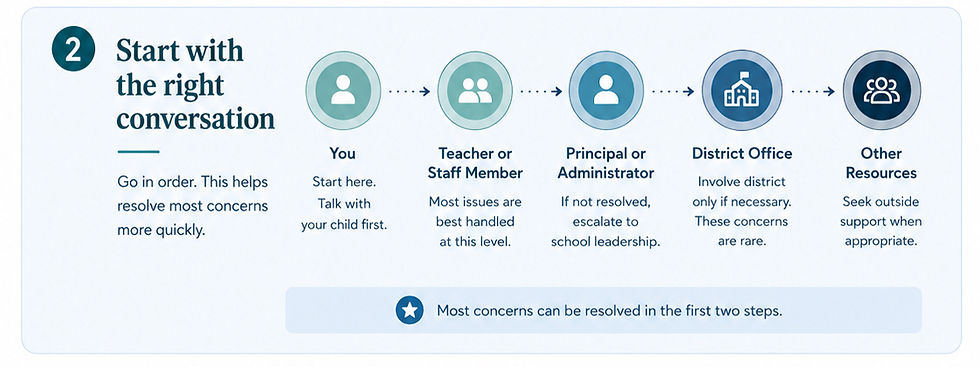
Questions worth asking first
A more grounded first step is to sort out what you know, what your child knows, and what still needs to be clarified. What facts do you actually have right now? What does your child most want adults to understand? Are you asking for clarity, support, repair, or some combination of the three?
Once you do reach out, strong first questions often sound more like this: How was this decision made? Was my child given an opportunity to share their perspective? How were expectations communicated? What support will be in place moving forward? Those are not weak questions. They are focused questions. They do not abandon standards or structure. They simply insist that process matters. Reframing a situation as a possible gap in voice rather than a conflict of sides creates more room for collaboration and usually leads to a better conversation.

Before you contact the school, it can help to slow the situation down and work through a few grounding questions first. This kind of preparation can help you separate facts from assumptions, clarify what your child most needs adults to understand, and enter the conversation with more steadiness.
A calmer first step is still a strong one
Parents do not need perfect language. They need enough clarity to avoid making a hard moment harder.
Some of the most useful advocacy work happens before the email is sent or the meeting is booked. It happens in the pause. In the sorting. In asking what your child understands, what still feels confusing, what you are really asking for, and what a helpful next step might look like.
If you start there, the conversation is more likely to protect what matters most. Not special treatment, but explanation, participation, and dignity. Not panic, but preparation. Not a fight for the sake of fighting, but a clearer path toward being heard.
If something about your child’s school experience feels unsettled, you do not need to carry that alone and you do not need to rush into the next conversation without support. Children are best served when parents and educators are not forced into opposite corners, but are working from a stronger shared language around voice, dignity, and participation. A better process helps everyone involved, but especially the child at the centre of it.


If you want the fuller support behind this page, the Parent Advocacy Conversation Guide was created to help parents prepare for these conversations with more clarity, less panic, and a stronger sense of what their child needs adults to understand.
The system we inherited was built for a different world
There is an old machine still running underneath much of modern schooling. You can hear it in the bells, the pacing, the routines, the pressure to keep things moving, and the quiet approval often reserved for students who are easiest to manage. You can feel it in the way sameness is still rewarded, in the way speed is often valued over reflection, and in the way compliance is too often mistaken for success. After more than twenty years in schools, I have come to believe that one of the most important truths we need to face is also one of the hardest to say plainly: this work is not for everyone.

It is not for teachers who simply want compliance in their rooms. It is not for those who believe the best classroom is the quietest one, or for those who still see education mainly as a process of getting students to fit smoothly into existing systems. And it is not for people who are comfortable with a version of schooling that still carries the logic of an older world, one that valued order, predictability, and obedience because those qualities made people easier to sort, manage, and direct.
The future will ask more than compliance
Public education has a much longer history than the industrial era, of course, but the version of schooling that took its modern shape during that time absorbed many of the values of that age. It had to scale. It had to organize large numbers of young people efficiently. It had to create routine, predictability, and standardization. It taught literacy and numeracy, yes, but it also taught punctuality, repetition, hierarchy, and compliance. In many ways, it became very good at preparing students to function inside systems built by others. On the surface, that may sound reasonable enough. We all want young people to grow into responsible adults. We all want them to contribute meaningfully to society. But responsible to what? Productive in service of what? Prepared for whose version of the future?
That is where the conversation becomes more uncomfortable, and more honest. Education cannot claim to stand for democratic values if its central task is training children to adapt quietly to whatever structures they inherit. It cannot call itself student-centered if the deeper design still rewards those who are easiest to manage and punishes those who do not move neatly through the machine. If we are honest, many of the systems we still defend were built for a world that no longer exists in the same form. We are not preparing students for assembly lines and rigid bureaucracies alone. We are preparing them for a world shaped by automation, artificial intelligence, information overload, social instability, ecological pressure, and moral complexity. We are asking them to navigate futures that will demand judgment, adaptability, ethical reasoning, collaboration, and courage. And yet many schools are still organized around compliance, sameness, and control.
That mismatch should concern us more than it does. The real problem is not only that schools are under pressure, though they certainly are. The deeper problem is that many of the structures we still treat as normal were designed for another time and are no longer sufficient for the lives students are moving into. If the future is going to ask more of our students than obedience, then school must ask more of itself. That is part of why this work feels difficult for some people. It asks adults to let go of some old comforts. It asks us to stop confusing silence with health and order with justice. It asks us to admit that a child can be compliant and still feel erased, fearful, disengaged, or unseen. It asks us to recognize that a well-run room from the hallway is not always a healthy room from the inside.

This work is not soft
This is where some people assume that a rights-informed approach must be soft, permissive, or vague. I do not believe that at all. The problem is not structure. The problem is what the structure is protecting. A classroom can have routines, boundaries, expectations, and strong adult leadership without organizing itself around control. In fact, I would argue that real structure becomes stronger when students understand it, trust it, and can see themselves inside it. Structure that protects safety, dignity, voice, and shared responsibility is not weaker than compliance-driven control. It is more demanding. It requires more judgment from adults, more reflection, more consistency in the right places, and more willingness to teach through conflict instead of simply shutting it down.
A more modern school is not automatically a more human school
And this matters even more as schools talk more and more about innovation, technology, and future readiness. We should be careful not to confuse modernization with transformation. A more digitized system is not automatically a more humane one. A school can become more data-rich, more automated, and more efficient without becoming more just. A classroom can be full of devices, dashboards, and personalized tools and still operate on a deeply old-fashioned belief about power, obedience, and control. A more sophisticated compliance system is still a compliance system. So the question is not whether schools will modernize. The question is what kind of future they are modernizing toward, and whether that future leaves enough room for dignity, thought, participation, and humanity.
What if schools prepared students for something better?
What if school became one of the last places where students learned how to remain fully human in a world that increasingly pressures people to become efficient, optimized, and easily managed? What if classrooms helped students learn how to disagree without humiliation, how to name a boundary, how to hear someone else’s boundary, how to repair harm, and how to participate in shared life without disappearing inside it? What if we treated safety, dignity, voice, and belonging not as extras, but as part of the architecture of serious learning? What if we prepared students not only to function in society, but to question it, shape it, and improve it?
That kind of future is not fantasy. Parts of it are already visible whenever educators choose to work this way. You see it when a student who usually withdraws begins to speak because they trust their voice will be taken seriously. You see it when a student who usually dominates begins, slowly, to make room for others. You see it when a repeated conflict stops being a cycle of blame and starts becoming a teachable moment with language for boundaries, rights, and repair. You see it when an adult pauses long enough to ask not just who broke the rule, but what was actually happening, whose dignity was affected, what structure was missing, and what needs to change next time. Those changes may not look dramatic from the outside, but they are deeply meaningful. They point toward a different vision of schooling.
Schools should serve students, not just systems
That is why I keep returning to the idea that schools should function as service industry. They should exist to serve the development of young people, not simply to preserve adult comfort or keep inherited systems running smoothly. They should treat students as rights-bearing people, not as units to be processed. They should create conditions where safety, dignity, participation, and shared responsibility are built into the daily life of the classroom. This work is not anti-structure, anti-accountability, or anti-expectation. It is a challenge to structures that have lost their moral center, to systems that protect order more readily than they protect people, and to habits of schooling that still confuse manageability with learning.
This work is not for everyone
So no, this work is not for everyone. It is not for those who want children silent more than they want them engaged. It is not for those who believe the future can be met with better obedience alone. It is not for those who want to keep protecting the machinery more than the human beings inside it. But it is for educators who know, even if only quietly at first, that the old model is no longer enough. It is for those who want structure without surrendering dignity, accountability without humiliation, and classrooms where student voice is not treated as a threat but as part of what makes a learning community real.
I believe the future is going to demand more humanity from our schools, not less. More judgment. More courage. More participation. More care in how we use power. More honesty about what students need in order to thrive. That kind of school will not build itself, and it certainly will not emerge from compliance alone.
But I would argue it is worth building anyway.
A school can look calm and still be failing children. The hallway can be quiet. The classroom can be orderly. The policy can be followed exactly as written. And a student can still walk away feeling misunderstood, humiliated, or entirely unseen. That is the danger of confusing order with care.
It is also why I keep returning to one line in my email signature: Make compassion your currency. I do not mean it as a pleasant sign-off. I mean it as a challenge. Because in too many schools, we have become very good at measuring what keeps the system comfortable and not nearly good enough at asking whether the learner in front of us was actually served.
Too often, the things that get treated as success are adult-centred things. A smooth day. A quiet room. A student who does not push back. A policy followed cleanly. A problem removed quickly. Those things can make a school feel efficient, but they do not tell us nearly enough about whether a student felt safe, understood, dignified, or genuinely reached.
That is a problem, because schools are supposed to serve students.
I know that phrase can make people nervous. When I say schools are a service industry, I am not saying teachers should act like retail workers or that children should dictate every decision. I am saying something much simpler and, to me, much more serious. We should be able to look at our structures and ask a basic question: who is this serving right now?

Sometimes the honest answer is not the student. Sometimes it is the timetable. Sometimes it is the adult’s need for control. Sometimes it is a district policy that was written broadly enough to cover everything and wisely enough to understand almost nothing. Sometimes it is the school’s desire to move a difficult moment somewhere else as fast as possible.
I have used the restaurant example before because it gets at something people in education often resist. If you open a restaurant, you do not start by saying, “Here is what I feel like making, and the customer’s experience is beside the point.” You study the community. You think about what people need. You bring your training, your judgment, and your craft. Then you listen closely enough to adjust.
A chef does not become less skilled by noticing that something is not landing. A good chef pays attention without giving up the craft. Education should be able to hold the same tension. Teachers and school leaders should be able to bring knowledge, standards, and professional judgment into the room without treating student experience as an inconvenience. That is where compassion comes in.
I do not mean compassion as sentimentality. I do not mean lowering expectations. I do not mean excusing every harmful choice because a student is having a hard time. I mean compassion as a working measure of whether our systems are doing what they claim to do.
Did the student experience relief?
Did they feel safe enough to stay connected?
Did they feel some dignity in the way the adult handled the moment?
Did they leave with a clearer path back into the learning community, or were they simply removed so the adults could breathe easier?
Those are not soft questions. Those are structural questions. They tell us whether we are building a school around human development or around adult convenience. This matters most when things get messy.
It is easy to talk about student-centred practice when students are agreeable and the day is calm. The real test comes when a student is grieving, dysregulated, angry, oppositional, withdrawn, or acting in a way that creates real tension for the adults around them. That is the moment when schools often reveal what their true currency is.
If the first instinct is exclusion, silence, removal, or blanket consequence, then the system is usually telling on itself.
I spoke about this on a podcast using an example of a student bringing alcohol to school while dealing with the death of a parent. The point was not that there should be no response. The point was that blanket policy often serves the adult system before it serves the child. If the only move available is suspension, the school may succeed in following procedure while completely failing the student. In that case, the policy has been served. The learner has not. That is the distinction I want school leaders to sit with.

A consequence can be consistent and still be unjust. A school can look orderly while students quietly experience it as a place where their context, identity, and humanity matter very little the moment things get hard.
This is why I think leadership matters so much here. Teachers work inside structures they did not build. They can do remarkable things in classrooms, but leadership decides every day whether the school will primarily protect policy or primarily serve students. Leadership decides whether “consistency” means thoughtful shared principles or mindless repetition. Leadership decides whether compassion is treated as weakness, or as evidence that the adults in the building understand what education is actually for. To me, compassion is the currency because it forces a better form of accountability.
Not: Did the student comply fast enough?
Not: Did the adult regain control quickly enough?
Not: Did we apply the consequence the way the handbook said?
But: What did this student experience in our care?
If the answer is humiliation, disconnection, fear, or removal, then something in the recipe needs to change. And that does not threaten professionalism. It demands it.
Professional judgment is not proven by how firmly we hold the line no matter what. Sometimes it is proven by whether we can recognize that the line, as currently drawn, is serving the wrong thing. Sometimes the most responsible move in a school is not tighter enforcement. It is better discernment. That is why I come back to compassion. Not as branding. Not as a personality trait. Not as a poster on the wall. As a real measure.
If our schools exist to serve students, then we should be able to tell by what students actually experience there. Joy matters. Relief matters. Safety matters. Wonder matters. Dignity matters. These are not extras that come after the real work. They are part of the real work.
So yes, keep your standards. Keep your structures. Keep your professionalism. But look honestly at what your system is paying attention to and what it is rewarding. If all the currency in the building goes to compliance, speed, quiet, and control, do not be surprised when students experience school as a place that manages them instead of one that serves them.
Make compassion your currency.
Then build, lead, and adjust accordingly.